


Urban lighting is not road lighting with nicer poles. Road lighting is solved by a calculation: illuminance, uniformity and glare on a carriageway. Urban lighting has to do that and then answer questions a calculation cannot — how the street looks by day, whether people feel safe crossing the square at eleven at night, what the light does to the trees and the residents’ bedrooms, and whether the town still owns spare parts in twelve years.
This guide is for the person writing the specification: the municipal engineer, the lighting designer, the landscape architect, the contractor pricing a public-realm package. It covers what urban lighting includes, the standards that govern it, the decisions that are expensive to reverse, and where project-specific manufacturing changes the answer.
What does urban lighting actually cover?
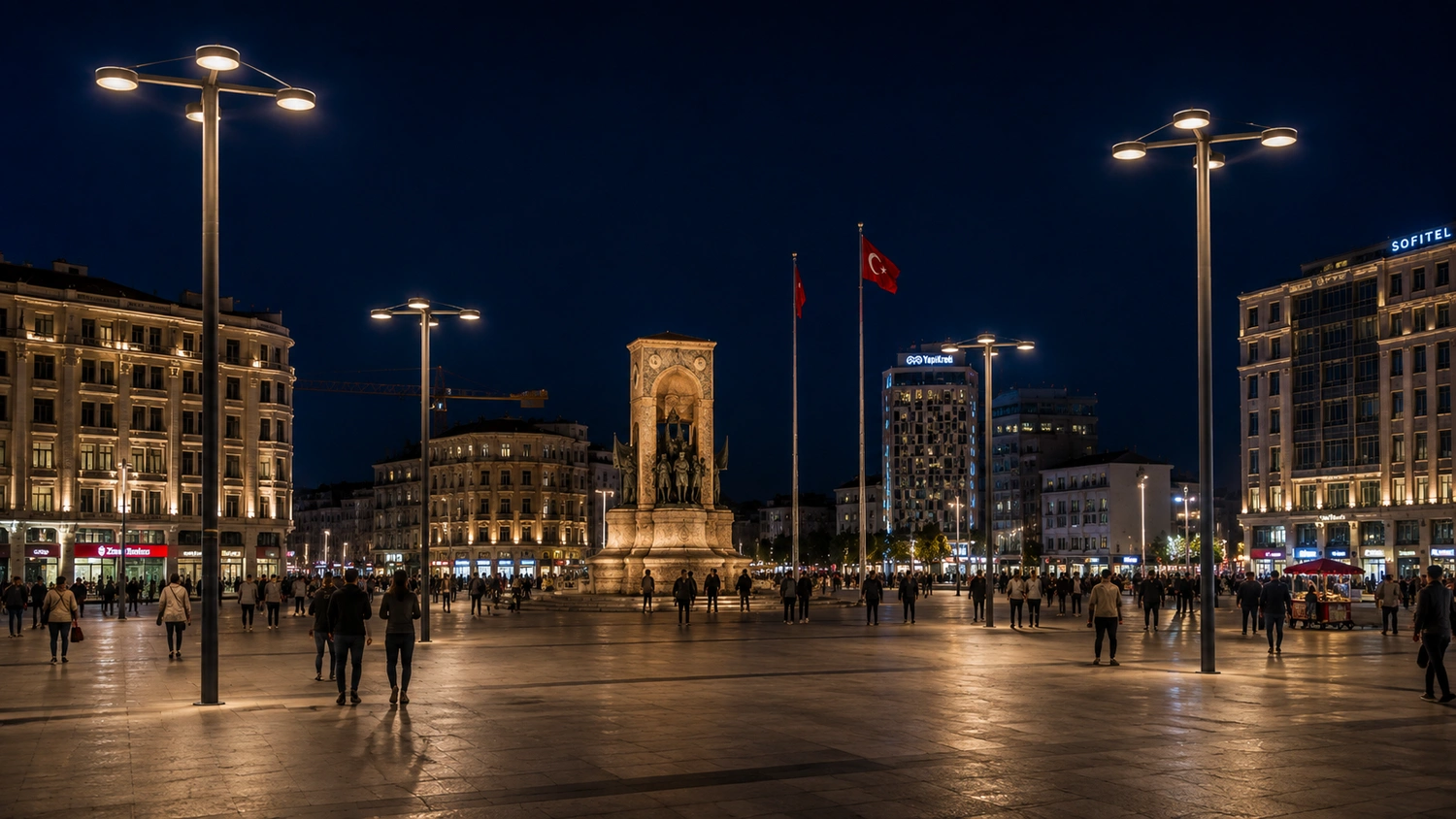
Urban lighting is the lighting of the public realm. In practice a public-realm package usually contains five product families, and they are specified against different criteria:
- Street and road lighting — poles from 6 to 12 m with road luminaires, specified to a lighting class.
- Pedestrian and amenity lighting — 3 to 5 m poles in squares, promenades and residential streets, where vertical illuminance on faces matters as much as horizontal levels on the ground.
- Bollards and low-level lighting — 0.6 to 1.2 m, for paths, landscape and building approaches, where glare control at eye level is the whole point.
- Decorative and architectural poles — the same lighting job, but the pole is part of the streetscape identity and is judged by daylight as much as at night.
- Park and landscape lighting — the family with the strongest ecological constraints, and the one most often over-lit.
Mixing families across one district without a coherent pole strategy is the most common reason a finished scheme looks unresolved. Deciding early that one pole family will carry every fitting — road, amenity, decorative — is worth more than any individual product choice.
Which standards govern urban lighting?
Three sets, and they answer different questions.
Lighting performance: the EN 13201 series. EN 13201-2 sets the performance requirements by lighting class — M classes for motorised traffic, C classes for conflict areas such as junctions and roundabouts, P classes for pedestrian and low-speed areas. EN 13201-3 covers how the calculation is performed, EN 13201-4 how the installation is measured once built, and EN 13201-5 energy performance indicators. The class is chosen from the road’s function, speed and conflict density; it is not a preference.
The pole: the EN 40 series. EN 40-2 for dimensions, EN 40-3-1 for characteristic loads, EN 40-3-3 for verification by calculation, EN 40-5 for steel columns and EN 40-6 for aluminium columns. Hot-dip galvanizing is covered by EN ISO 1461. Where poles sit close to traffic, EN 12767 covers passive safety — whether the pole is designed to absorb or yield in an impact.
The luminaire: EN 60598-2-3 for road and street lighting luminaires, plus the IP and IK ratings. IP66 and IK08 are common baselines in the public realm; IK10 where vandalism is a real risk.
Artay luminaires are CE marked, and our manufacturing is certified to TSE under TS EN 40 for lighting columns and to ISO 9001 for quality management. For Turkish municipal work, TEDAS type-project approval is the document the tender will ask for.
Obtrusive light: the requirement that arrives late and costs the most
Light that leaves the site is the fastest-growing source of objection to urban schemes, and it is usually raised after the design is fixed. CIE 150 sets the framework, using environmental zones from E0 (intrinsically dark, such as a national park) through E1 and E2 (rural and low-district brightness) to E3 and E4 (suburban and city centre). Each zone has limits on upward light, on light trespass into windows, and on luminaire intensity toward observers.
Three decisions carry most of the outcome. Optical control: a full cut-off distribution with an upward light ratio of zero puts light on the ground rather than the sky, and costs nothing extra to specify. Mounting height and tilt: tilting a flat-glass luminaire to gain reach is the single most common way a compliant product becomes a non-compliant installation. Colour temperature: warmer sources around 3000K, and increasingly 2700K near habitats, reduce blue content — which matters for sky glow, for insects and for residents, and is now written into many municipal specifications by default.
None of these are luxury items. Getting them wrong produces complaints, and complaints produce retrofits.
Choosing the pole: the decision that outlives the luminaire
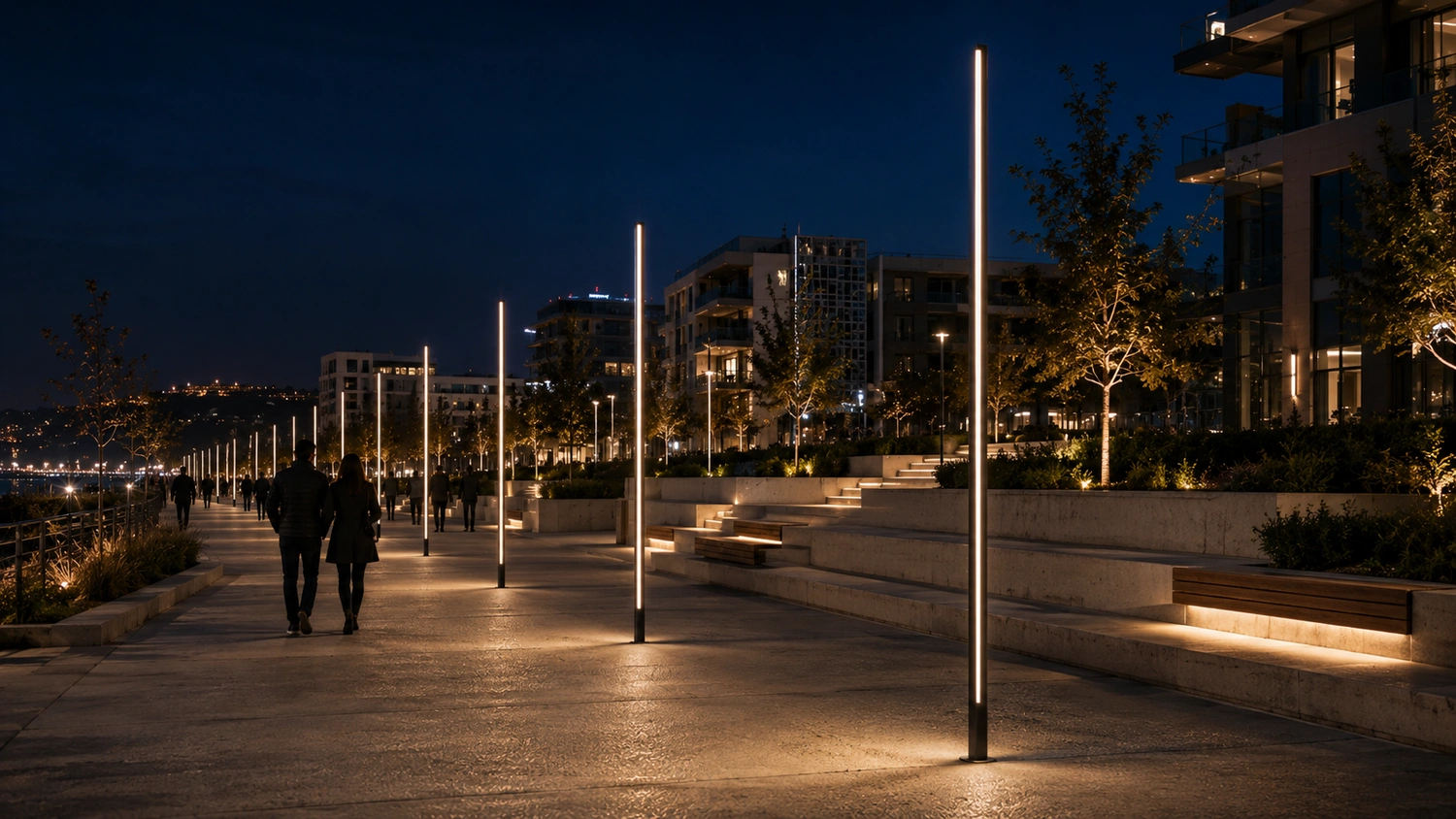
LED modules and drivers will be replaced once or twice in the life of a scheme. The pole will not. It is the longest-lived component in the package and it carries the visual identity of the street, so it deserves more specification attention than it usually gets.
Material is decided by environment before aesthetics. Hot-dip galvanized steel for road poles inland; aluminium at the coast, at ground level and wherever the shape matters. Bollards are aluminium — we do not make them from galvanized steel at all, because ground level is the harshest position on any site. The full comparison is in our guide to lighting pole materials, including what happens at the joint where steel meets aluminium.
Type and height follow the lighting class and the street section. Our guide to street lighting pole types covers conical and cylindrical steel, extruded profile, die-cast aluminium and bollards, with the height bands each is normally specified in.
Finish is where long-term appearance is won or lost. Every aluminium part we produce goes through a chromate conversion pre-treatment before electrostatic powder coating. Ask every supplier which conversion coating they use, not just which paint — it is the invisible step that decides how a bollard looks in year five.
Can a city have its own pole?
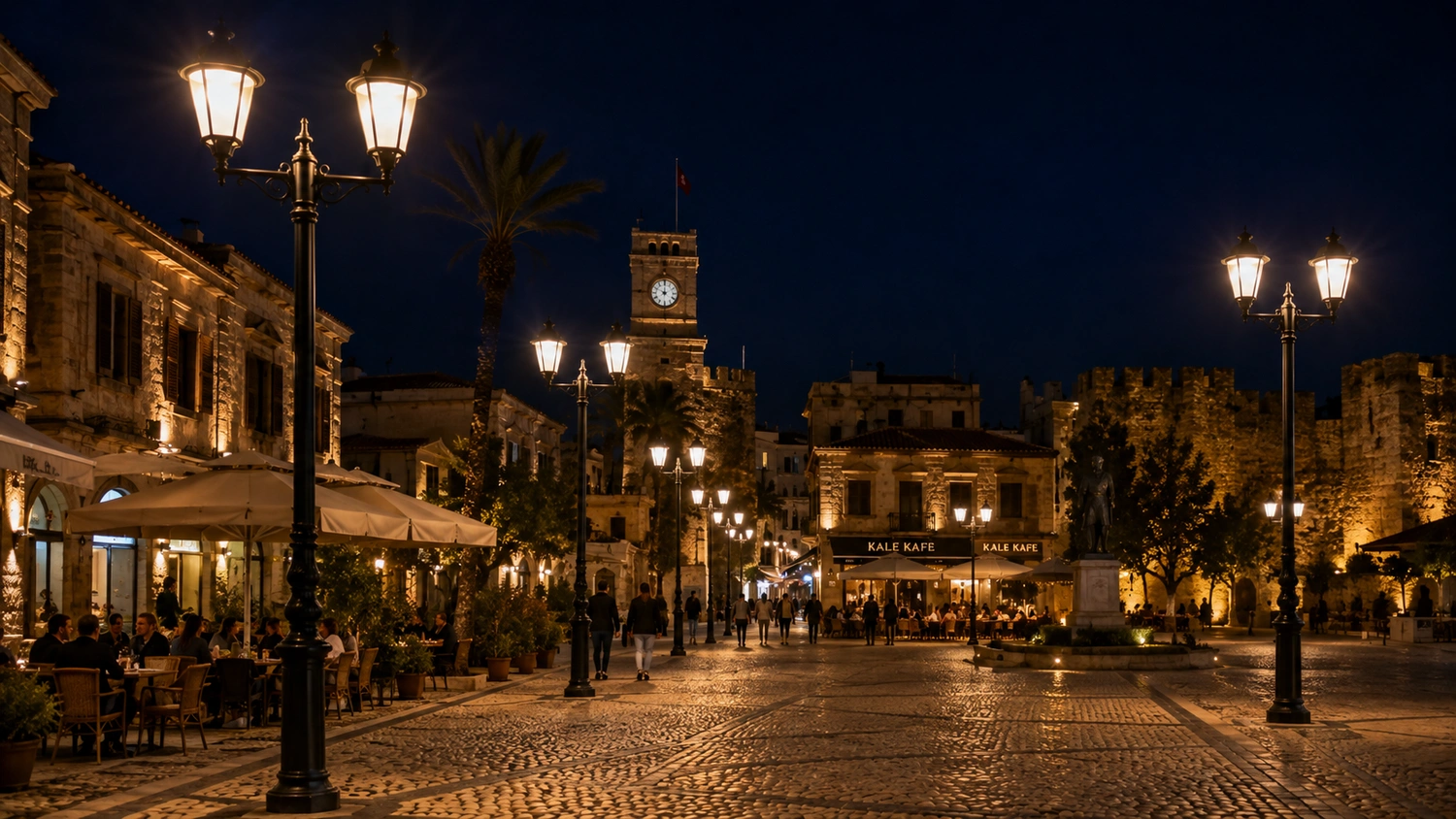
Yes, and this is where urban lighting separates from road lighting most clearly. A district that wants a recognisable identity does not get it from a catalogue everyone else buys from.
Two levels are worth distinguishing, because suppliers blur them. Changing dimensions — height, diameter, arm length, door position, base plate pattern, RAL colour — is a fabrication change. It carries no tooling cost and no minimum order, and if your specification differs from a catalogue only in numbers you should not be paying for a mould.
Changing the form — a base carrying the municipality’s emblem, a fluted column, a housing profile matched to a heritage facade — has to be cast, and casting needs a die. Artay has cast aluminium in its own die-cast foundry in Istanbul since 1999, in EN AC-46000 (AlSi9Cu3) alloy, so this is routine work rather than a special request. Send a technical drawing, a 3D model, or a photograph of a form you have seen in another city.
The figures, which almost nobody in this market publishes: a new mould is a one-time cost of 4,000-50,000 USD depending on part size and stays reserved for you; minimum order on a new mould is 1,000-2,000 units; the die takes 4-6 weeks and series production a further 3 weeks, so first delivery lands 7-9 weeks after drawing approval. Every repeat order on that mould ships in 3 weeks with no further mould charge and no minimum — which is what makes a bespoke pole family viable for a city that will keep extending it for a decade.
Specifying for the twelfth year, not the first
Urban lighting is bought once and maintained for decades, so the questions that decide total cost are rarely the ones in the tender.
Will the parts still exist? A custom mould that stays reserved means the twentieth pole matches the first one, years later. A catalogue product from a supplier who changes range every three years does not give you that.
Can one person replace a module? Toolless access, a plug-in driver and a documented spare-part list turn a two-hour job into a fifteen-minute one, multiplied by every fitting in the district.
What is actually warranted? Ask for the coating warranty stated separately for coastal and inland conditions, with the film thickness, and for the LED lifetime as an L-value at a stated ambient temperature rather than a single hour figure.
Who did the wind-load calculation? EN 40-3-1 and EN 40-3-3, covering the pole, the base plate and the foundation anchors together. If the answer is vague, the calculation may not exist.
Working with Artay on an urban lighting project
We manufacture street lighting poles, decorative and urban poles, LED street luminaires and bollard lighting for municipalities, infrastructure contractors, architects, lighting designers and distributors, and we export to more than 33 countries. Housings and cast pole components are produced in our own die-cast foundry in Istanbul; steel shafts are fabricated and hot-dip galvanized to EN ISO 1461; aluminium parts are chromate pre-treated before powder coating.
We do not make high-mast poles, and for a standard galvanized road pole in volume a dedicated steel fabricator will often beat us on price. Where we are the right supplier is when a project needs a form that does not exist yet, or a single supplier for poles, luminaires and bollards that have to look like one family.
Send a drawing, a 3D model, a photograph or a written specification to info@artaylighting.com and we will return a technical drawing with a wind-load calculation.
Related guides
- Ancient cities collection — the fifty models named after ancient Anatolian settlements, with the site behind each name.
- Street lighting pole types — how to choose the right one for your project.
- Lighting pole materials — galvanized steel or aluminium, and what happens where they meet.
- Street lighting pole manufacturers in Turkey — what nine manufacturers publish about casting, standards and lead times.
- Decorative lighting poles — styles and materials for parks, plazas and pedestrian zones.
- Street lighting poles — heights, galvanized steel and what a custom pole costs.
- Garden and landscape lighting — mounting heights, EN 13201 P classes and the obtrusive light zones that decide a park or garden scheme.
Specifying bollards? Bollard lights: how to choose and specify them — why they are aluminium and not galvanized steel, glare control at eye level, and which standard actually applies.