


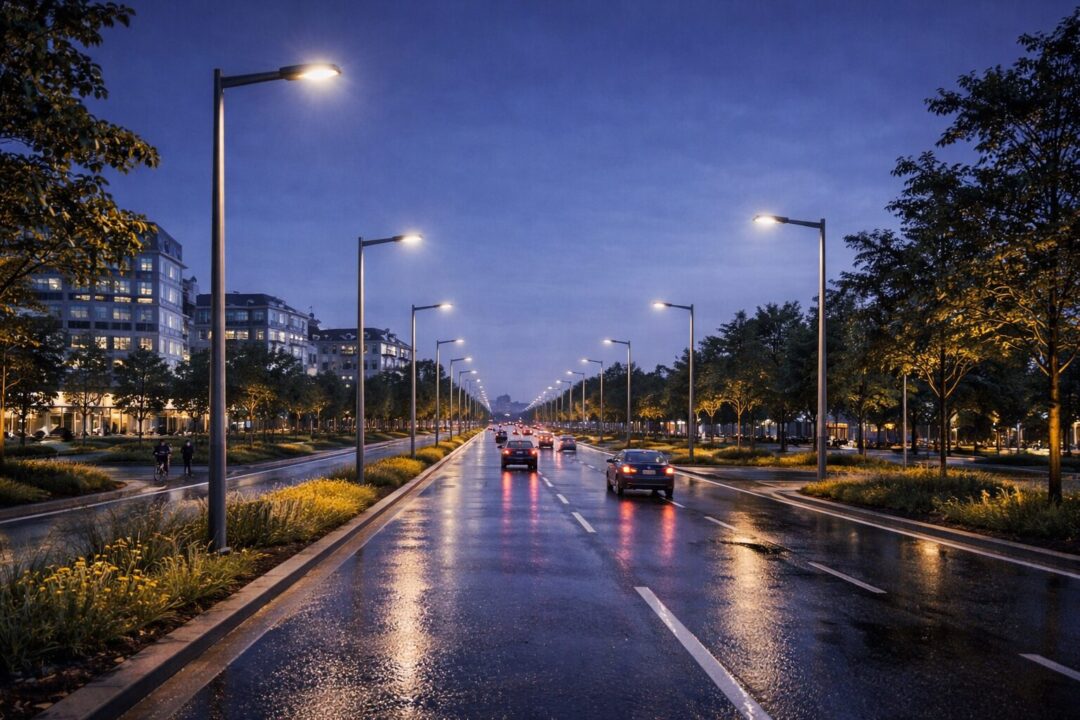
Artay Lighting manufactures street lighting poles in Istanbul, Turkey, casting housings and pole components in its own die-cast foundry since 1999. That means a project-specific pole is not a special favour here: when a municipality, contractor or distributor needs a form that does not exist in any catalogue, we cut the die and produce it. First delivery runs 7-9 weeks from drawing approval. Once the mould exists, repeat orders ship in 3 weeks. Artay exports poles and luminaires to more than 33 countries.
This guide covers the most common street pole types, recommended height ranges, the specifications worth checking, and what a custom pole actually costs.
How much does a custom street lighting pole cost, and how long does it take?
A new mould is a one-time cost of 4,000-50,000 USD depending on part size, and the tool stays reserved for the customer. Minimum order on a new mould is 1,000-2,000 units, again depending on part size. Repeat orders on an existing mould carry no further mould cost and no minimum.
Timing breaks down in two stages. Cutting the die takes 4-6 weeks from drawing approval. Series production takes a further 3 weeks. So a first delivery lands 7-9 weeks after you approve the drawing, and every order after that ships in 3 weeks.
Unit price depends on height, material, finish and quantity. Send a drawing, a 3D file or a photograph of a reference form to info@artaylighting.com and we return a technical drawing with a wind-load calculation and a quotation.
Figures reflect Artay production data at our Basaksehir foundry, August 2026.
Which standards do Artay street lighting poles comply with?
Artay luminaires are CE marked, and our manufacturing is certified to TSE under TS EN 40 for lighting columns, and to ISO 9001 for quality management. Die-cast components are produced from EN AC-46000 (AlSi9Cu3) aluminium alloy; steel shafts are hot-dip galvanized. For every project we confirm in writing, before production starts, which standards and which TEDAS specifications the delivered poles are built to.
What are street lighting poles used for?
Street poles are designed for vehicle-focused lighting, visibility, and road safety across different road classes:
- Residential streets and local roads
- Main roads and boulevards
- Medians and divided highways (project dependent)
- Intersections, roundabouts, and critical junctions
- Industrial roads and logistics access routes
Types of street lighting poles
The correct type depends on road width, lighting layout, luminaire weight, and wind exposure.
1) Single-arm street lighting poles
- Most common solution for standard streets
- Clean appearance and easier maintenance
- Arm outreach must match photometrics (avoid guessing)
2) Double-arm street lighting poles
- Used for wider roads, medians, and boulevards
- Can improve coverage symmetry when designed properly
- Requires stronger foundation and wind verification
3) Tapered conical vs. octagonal poles
- Tapered conical: minimal silhouette, strong wind behavior, very popular
- Octagonal: sharper architectural look, common in modern streetscapes
4) Smart-ready street poles
- Supports smart controllers, sensors, cameras, banners (project dependent)
- Cleaner wiring paths and service access become critical
Recommended heights for street lighting poles
Use these ranges as a starting point. Final heights should follow spacing and luminaire photometrics:
- 6–8 m: residential streets, local roads
- 9–10 m: main roads and wider streets
- 12 m: boulevards and large open road sections
Height choice is never “only aesthetic.” It controls spacing, uniformity, glare, and overall road visibility.
Materials: why galvanized steel dominates street projects
Hot-dip galvanized steel
- Strong, durable, and cost-effective for road infrastructure
- Excellent corrosion resistance when galvanizing is done correctly
- Compatible with powder coating for premium finishes
Aluminum (when it makes sense)
- Lightweight handling advantages
- Naturally corrosion resistant
- Often selected for premium or special-case installations
Important: long-term performance depends on manufacturing quality, coating system, and correct foundation detail—not only the metal type.
Coatings & finishes for street environments
Street poles face UV, rain, dust, and abrasion. Choose a finish system based on climate and expectations:
- Hot-dip galvanizing: base corrosion protection
- Powder coating: appearance + extra protection
- Multi-layer systems: recommended for harsh climates (coastal/industrial)
Specify clearly:
- Color (RAL code)
- Texture (matte / satin)
- UV resistance expectations
- Maintenance/touch-up approach
Key specifications to check before ordering
1) Wind load and structural compliance
Wind exposure increases with height and bracket outreach. Confirm structural calculations suitable for the project location.
2) Bracket/arm outreach
- Outreach affects beam distribution and glare control
- Match arm selection to luminaire photometrics
3) Base plate, anchor bolts, and foundation detail
- Foundation must match wind + height + luminaire weight
- Ask for anchor bolt pattern and base dimensions
4) Access door, wiring, and grounding
- Serviceability matters for maintenance teams
- Ensure safe cable routing and grounding provision
5) Luminaire compatibility
- Spigot/top diameter compatibility
- Mounting method and tilt adjustability if needed
How to choose street lighting poles (simple checklist)
- Define road type and width (residential, main road, boulevard)
- Select target height range based on coverage and spacing
- Choose single or double-arm configuration
- Pick material + coating system for the climate
- Confirm wind load and foundation requirements
- Lock luminaire compatibility and service access
- Standardize pole families for consistent streetscapes
Browse street lighting models
Explore models and options in our Street Lighting category and select a pole family based on your target heights and bracket type.
Related pole guides
- What drives the cost of a lighting pole — what moves the price, what a quotation leaves out, and how to compare two of them.
- Coastal lighting poles — chloride, chromate pre-treatment and what changes in a seaside specification.
- Modern outdoor lighting poles — LED-ready pole designs and materials for streets, parks and new developments.
- Outdoor lighting poles — types, heights and materials for any outdoor project.
- Decorative lighting poles — styles and materials for parks, plazas and pedestrian zones.
- Modern lighting poles — design and material choices for public spaces, cast to drawing in our own foundry.
Specifying bollards? Bollard lights: how to choose and specify them — why they are aluminium and not galvanized steel, glare control at eye level, and which standard actually applies.
Steel or aluminium? Lighting pole materials: galvanized steel or aluminium — coastal performance, chromate pre-treatment, and what happens at the joint where the two metals meet.
Not sure which type you need? Street lighting pole types: how to choose the right one — steel, extruded aluminium, die-cast and bollards compared on height, corrosion environment, EN 40 standards and what changes when the form is made to your own drawing.
Choosing a supplier? Street lighting pole manufacturers in Turkey: how to compare them — what nine Turkish manufacturers publish about casting, standards, certificates and lead times, and the five questions worth asking every supplier.
All of these poles are produced by the same manufacturer: Artay casts housings and pole components in its own die-cast foundry in Istanbul, which is why a form that exists in no catalogue can still be produced. See the LED lighting fixtures manufacturer in Istanbul behind these guides, or browse the full outdoor and street lighting product range.
Need help selecting street lighting poles?
Share your project location, target heights, road width, and luminaire model. We can recommend a pole family and coating system designed for long-term street performance.
Related guides
- Lighting pole standards by country — eight export markets side by side: what each tender cites, where it is published and what crosses the border.
- EN 40 lighting column standards — what each part of the series actually covers.
- Lighting pole materials — galvanized steel or aluminium, and what happens where they meet.
- Aluminium or galvanized steel — which one belongs in your specification, decided by corrosivity and height.
- What a lighting pole costs — mould economics, minimum orders and lead times in full.
- Garden and landscape lighting — mounting heights, EN 13201 P classes and the obtrusive light zones that decide a park scheme.