

OEM lighting pole manufacturing has two completely different price structures, and most suppliers answer as if it were one question. Changing the dimensions of an existing pole — height, diameter, wall thickness, arm length, door position, base plate pattern, RAL colour — carries no tooling cost and no minimum order, because those are cutting and rolling parameters. Changing the form means casting a shape that does not yet exist, which needs a die: a one-time cost of 4,000–50,000 USD and a minimum order of 1,000–2,000 units. Knowing which of the two you are asking for is the whole negotiation.
Artay Lighting has cast aluminium in its own die-cast foundry in Istanbul since 1999, exports to more than 33 countries, and manufactures under other brands’ names as a matter of routine. This page sets out what we can and cannot do under OEM and private label, what it costs, how long it takes, and what a distributor should ask before placing a first order.
What is the difference between OEM and private label here?
In this market the two words are used loosely, so it is worth being precise. Private label normally means an existing Artay model supplied under your brand: your name on the product, your catalogue, your packaging and documentation, with the design unchanged. OEM normally means we manufacture to your design or your modification of ours — a different form, a different housing, a base carrying your emblem — and the tooling for that form is cut for you.
The commercial consequence is simple. Private label has no tooling cost and no minimum beyond a normal production run, so it can start small. OEM with a new form has a tooling cost and a minimum, and it makes sense when the volume justifies owning a shape nobody else can supply.
What does OEM tooling cost, and how long does it take?
These are the figures, published because almost nobody in this category publishes them and a distributor cannot plan without them.
| Item | Figure |
|---|---|
| New mould, one-time cost | 4,000–50,000 USD, depending on part size |
| Minimum order on a new mould | 1,000–2,000 units |
| Cutting the die | 4–6 weeks, in our own tool shop |
| Series production after that | 3 weeks |
| First delivery, from drawing approval | 7–9 weeks |
| Repeat order on an existing die | 3 weeks, no mould charge, no minimum |
| Dimensional change only, no new form | No tooling cost, no minimum |
The point worth planning around is the last row of that table. The first order on a new form is the expensive one; every order after it ships in three weeks with no minimum and no further tooling charge. Distributors who treat the mould as an entry cost rather than a per-project cost get the economics right.
What can be branded, and what cannot?
Under private label the brand appears where you would expect it: the product marking, the packaging, the catalogue and the technical documentation supplied with the order. Under OEM with a new die, the form itself can carry a brand element — a municipality’s emblem in a base, a housing profile matched to a facade, a column silhouette unique to one city — because a cast part comes from a mould and the mould is cut to your drawing.
What does not change is the certification chain. Artay luminaires are CE marked, and manufacturing is certified to TSE under TS EN 40 for lighting columns and to ISO 9001 for quality management. Those certificates are issued to the manufacturer and describe the manufacturing, whoever the product is branded for. Ask for the certificate together with its scope and expiry — and read the scope, because a certificate covering luminaires does not cover columns, and the two are frequently confused in tender documents.
What do we actually make?
Cast aluminium is the core: bollards, urban and decorative pole components and luminaire housings, cast in our own foundry in Başakşehir, Istanbul, in EN AC-46000 (AlSi9Cu3) alloy, with a chromate pre-treatment before electrostatic powder coating. Alongside it we fabricate hot-dip galvanized steel poles to EN ISO 1461, up to 12 m, specified to the EN 40 series, and we fabricate from extruded aluminium profile. Which of the two a given product should be made from is a separate question, answered in aluminium or galvanized steel: which should you specify.
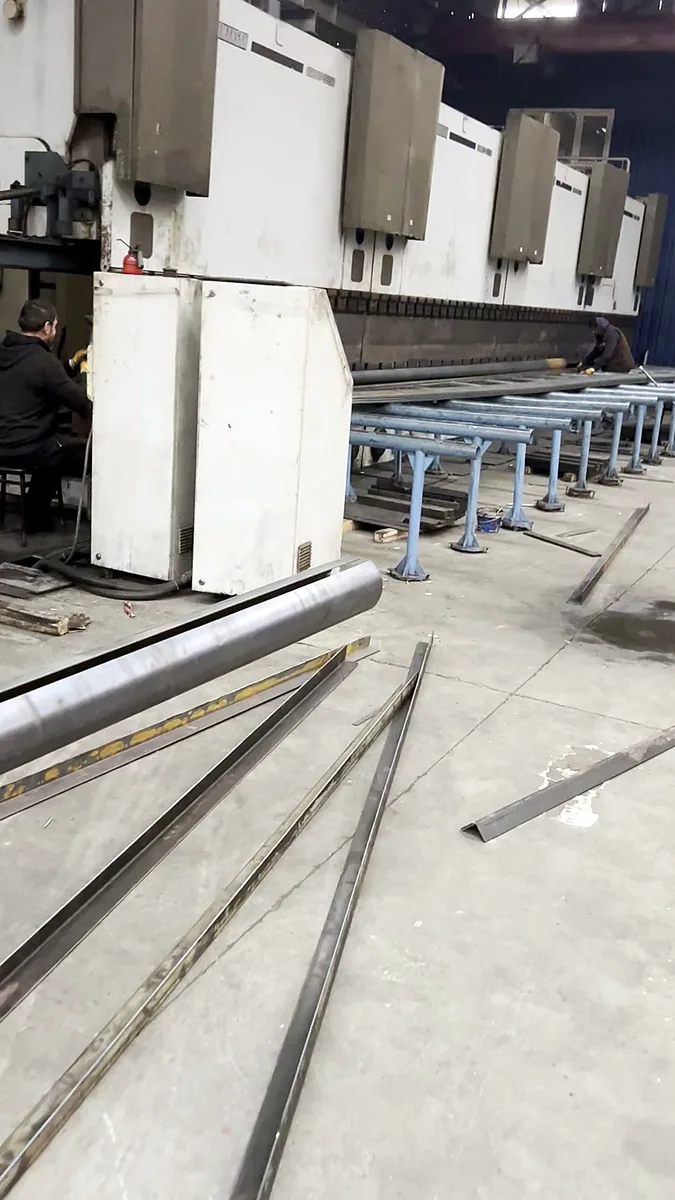
Two things we say plainly, because a distributor finds them out eventually anyway. We do not make high-mast poles. And we buy in extruded aluminium profile rather than extruding it ourselves, as most of this market does; what is ours is the die-casting and the tool shop behind it.
What should a distributor ask before the first order?
Ask whether the supplier owns the casting or buys it in, because that determines whether a form change is a negotiation or an impossibility. Ask for the mould cost and the minimum in writing, separately from the unit price. Ask what the repeat-order lead time is on an existing tool, since that is the number you will live with. Ask who holds the tooling and on what terms. Ask for the certificate scope rather than the certificate logo. And ask what pre-treatment is applied before coating — “powder coated” on its own is not an answer, and on coastal projects it is the detail that decides year eight.
We answer all of those before an order rather than after it, and the figures above are the same ones we quote.
How to start
Send a drawing, a 3D model, a photograph of a form you have seen, or simply a written specification to info@artaylighting.com. We return a technical drawing with a wind-load calculation, the tooling cost if a new die is needed, and a delivery date. If the quantity does not justify a mould, we will say so and propose the form in fabricated steel or extruded profile instead.
Related guides
- What drives the cost of a lighting pole — what moves the price, what a quotation leaves out, and how to compare two of them.
- Street lighting pole types — the four families, and what a custom form costs in each.
- Lighting pole materials — galvanized steel, cast aluminium and extruded profile compared.
- How to compare Turkish pole manufacturers — what nine of them publish about casting, standards and lead times.
- Ancient cities collection — the fifty models available under private label.
- Street lighting poles — heights, standards and what a custom pole costs.
- Street lighting poles for Iraq – what Ministry of Electricity specification D-13 requires, and why EN 40 alone is not an answer there.
- Lighting poles for Kuwait – why MEW/S-1 excludes street lighting columns, and what applies instead.
- Lighting poles for Serbia – SRPS EN designations, CE alongside the domestic 3A mark, and a Serbian-language Declaration of Performance.
- Lighting poles for Moldova – the EN 40 series named by the energy regulator, and a 64-degree annual range.
- The EN 40 series explained – which part does what, which one carries CE marking, and what EN 40 leaves to other standards.