


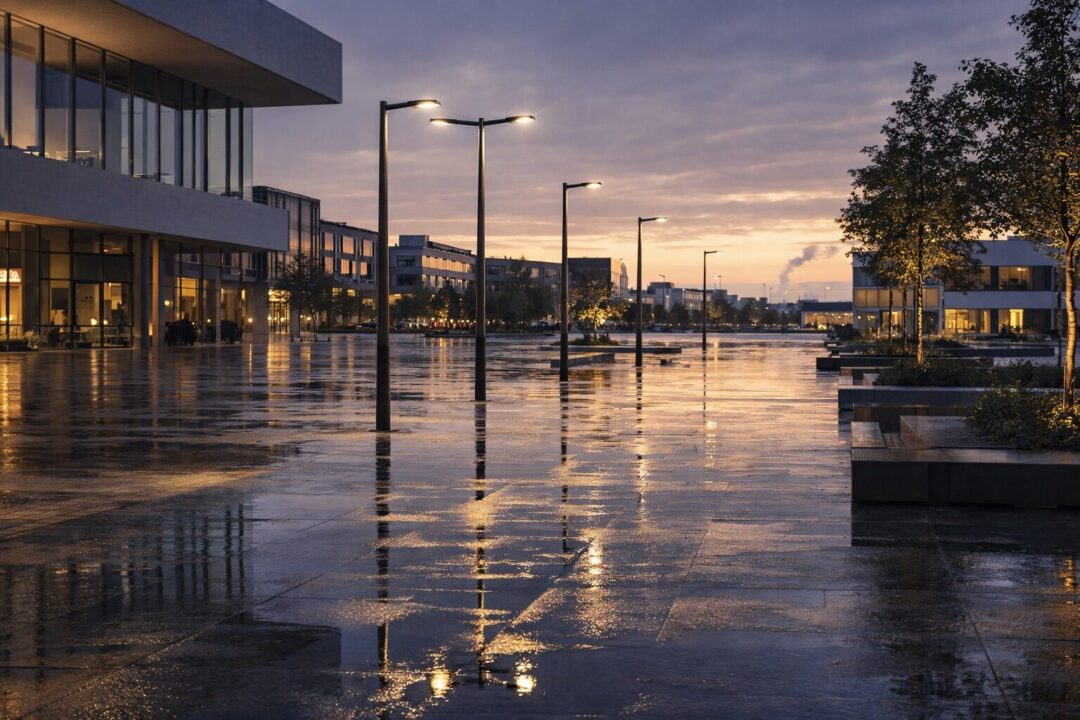
“Modern” in a lighting pole is a manufacturing question before it is a styling one. Clean lines, concealed wiring and a slim section are all decisions about how the part is made: a cast component can hold a shape a fabricated one cannot, and a fabricated one carries load a cast one need not. Which is why the useful question is not which style you prefer, but whether the supplier can produce the form at all.
Artay Lighting has cast aluminium in its own die-cast foundry in Istanbul since 1999 and exports to more than 33 countries. This guide covers the design decisions, the materials, the standards that apply, and what it costs to have a form made that is not in anyone’s catalogue.
What makes outdoor lighting poles “modern”?
“Modern” in outdoor lighting isn’t only a visual style—it’s a combination of form, engineering, and LED compatibility. Modern outdoor poles typically feature:
- Minimal silhouettes: tapered conical, clean round, or crisp octagonal profiles
- LED-ready integration: designed for modern luminaires and mounting standards
- Cleaner details: tidy access doors, hidden cable routing, and refined base proportions
- Project consistency: a family of matched heights, arms, and finishes across the site
- Smart-ready options: support for controllers, sensors, cameras, or banners when needed
Where modern outdoor lighting poles are used
- Urban streets and boulevards
- Parks, pathways, and waterfront promenades
- Residential communities and mixed-use developments
- Commercial zones, parking areas, and business districts
- Campuses, hospitals, and public institutions
- Industrial sites where a clean, durable standard is required
Types of modern outdoor lighting poles
The “best” pole type depends on the lighting plan, area scale, wind exposure, and luminaire requirements. Here are the most common modern configurations:
1) Tapered conical modern poles
- Most popular for streets and large outdoor projects
- Strong structural behavior under wind load
- Premium, minimal appearance
2) Straight round or octagonal poles
- Sharper architectural expression than conical forms
- Often used in campuses, plazas, and modern developments
3) Single-arm vs. double-arm modern poles
- Single-arm: cleaner look, common for streets and one-side illumination
- Double-arm: wider roads, medians, and boulevard projects
4) Smart-ready modern poles
- Supports accessories (controllers, sensors, cameras, banners)
- Requires cleaner wiring paths and service access
Recommended heights (practical ranges)
Use these as a starting point—final heights should follow photometrics and spacing design:
- 3–5 m: pedestrian zones, parks, pathways
- 6–8 m: residential streets, smaller roads, community areas
- 9–12 m: boulevards, main roads, larger open spaces, parking areas and large commercial or industrial zones
Materials and durability: what to choose
Galvanized steel (hot-dip galvanized)
- Strong and cost-effective for modern outdoor projects
- Excellent corrosion resistance when galvanizing is done correctly
- Ideal base for powder coating (premium finishes)
Aluminum
- Lightweight and naturally corrosion resistant
- Often selected for premium landscapes and easier handling
- Supports refined finishing and clean surface appearance
Key point: long-term performance depends on coating quality and surface preparation as much as the metal itself.
Coatings & finishes for modern outdoor poles
Modern poles often use matte or satin powder-coated finishes for a premium look. To keep that look outdoors, the finish system must match the environment:
- Hot-dip galvanizing as base protection
- Powder coating for color + extra durability
- Multi-layer coating systems for harsh climates (coastal/industrial)
Define in your spec:
- Color (RAL code)
- Texture (matte / satin)
- UV resistance expectations
- Touch-up and maintenance approach
Key specifications to check before you buy
1) Wind load and structural compliance
Modern poles can be slimmer and taller, so wind engineering is critical. Confirm structural calculations for the project location.
2) Base plate, anchor bolts, and foundation details
- Foundation must match wind load + height + luminaire weight
- Ask for anchor bolt pattern and base dimensions
3) Arm/bracket type and outreach
- Outreach affects beam distribution and glare control
- Match pole arms to luminaire photometrics
4) Access door, wiring, and grounding
- Service access should be durable and easy for maintenance teams
- Cable routing and grounding provision must be clear
5) Luminaire compatibility
- Spigot/top diameter compatibility
- Mounting method and tilt adjustability if needed
Which standards apply to a modern outdoor pole?
A slim silhouette does not exempt a column from verification. The EN 40 series governs lighting columns — EN 40-2 for dimensions and tolerances, EN 40-3-1 for characteristic loads, EN 40-3-3 for verification by calculation, EN 40-5 for steel and EN 40-6 for aluminium — and the slimmer the section, the more the calculation matters. Road lighting performance is set by the EN 13201 series. For Turkish municipal and TEDAŞ work, TEDAŞ type-project approval is the document that will be asked for.
Artay luminaires are CE marked, and manufacturing is certified to TSE under TS EN 40 for lighting columns and to ISO 9001 for quality management. Cast bodies are produced in EN AC-46000 (AlSi9Cu3) alloy with a chromate pre-treatment before electrostatic powder coating.
Can a modern pole be made to your own design?
Yes, and the cost depends entirely on which kind of change you mean. Changing dimensions — height, diameter, wall thickness, arm length, door position, base plate pattern, RAL colour — needs no tooling and carries no minimum order. Changing the form means cutting a die: 4,000–50,000 USD one-time depending on part size, minimum 1,000–2,000 units, die cut in 4–6 weeks, first delivery 7–9 weeks after drawing approval, repeat orders in 3 weeks with no further charge and no minimum.
Send a drawing, a 3D model or a photograph and we return a technical drawing with a wind-load calculation before anything is committed. Two limits stated plainly: we do not make high-mast poles, and we buy in extruded aluminium profile rather than extruding it ourselves, as most of this market does. The commercial detail is on the OEM and private label page; our own decorative range is indexed in the ancient cities collection.
How to choose modern outdoor lighting poles (simple checklist)
- Define the area type (street, park, development, parking)
- Select height range based on coverage and spacing
- Choose pole profile (conical/round/octagonal) for project style
- Pick arm/bracket type and outreach
- Select material + coating system for the climate
- Confirm wind load and foundation requirements
- Standardize a pole family for consistent design and maintenance
Browse modern outdoor pole models
If your project is street-focused, browse models in our Street Lighting category and select a modern pole family that matches your target heights and bracket style.
Need help selecting modern outdoor lighting poles?
Share your project location, target heights, road widths, wind exposure level, and the luminaire model. We can recommend a modern pole family and finish system designed for long-term outdoor performance.
Related pole guides
- Street lighting poles — types, heights, galvanized steel and what a custom pole actually costs.
- Outdoor lighting poles — types, heights and materials for any outdoor project.
- Decorative lighting poles — styles and materials for parks, plazas and pedestrian zones.
- Modern lighting poles — design and material choices for public spaces.
Specifying bollards? Bollard lights: how to choose and specify them — why they are aluminium and not galvanized steel, glare control at eye level, and which standard actually applies.
Steel or aluminium? Lighting pole materials: galvanized steel or aluminium — coastal performance, chromate pre-treatment, and what happens at the joint where the two metals meet.
Not sure which type you need? Street lighting pole types: how to choose the right one — steel, extruded aluminium, die-cast and bollards compared on height, corrosion environment, EN 40 standards and what changes when the form is made to your own drawing.
Choosing a supplier? Street lighting pole manufacturers in Turkey: how to compare them — what nine Turkish manufacturers publish about casting, standards, certificates and lead times, and the five questions worth asking every supplier.
All of these poles are produced by the same manufacturer: Artay casts housings and pole components in its own die-cast foundry in Istanbul, which is why a form that exists in no catalogue can still be produced. See the LED lighting fixtures manufacturer in Istanbul behind these guides, or browse the full outdoor and street lighting product range.