


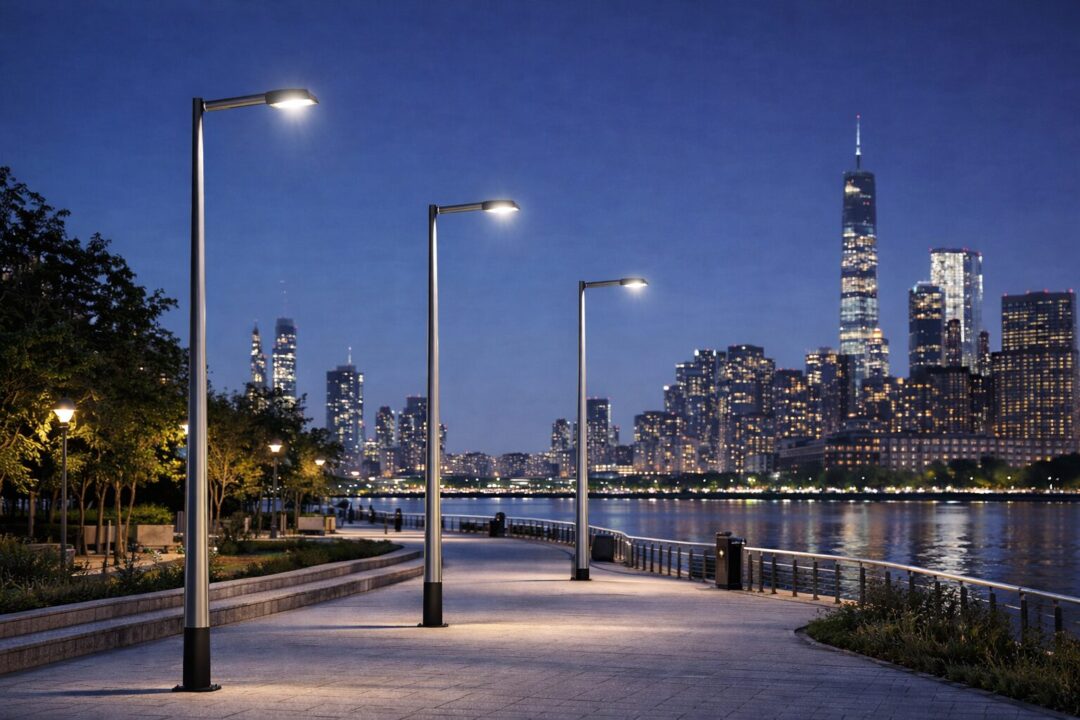
A modern lighting pole is a structural component first and a design object second. It carries a luminaire on a lever arm in wind, stands in the same square for thirty years, and has to be verified to EN 40 before any of its styling matters. The design question — clean lines, concealed wiring, a form that suits the architecture — is real, but it is decided after the structure is settled, not instead of it.
Artay Lighting has cast aluminium in its own die-cast foundry in Istanbul since 1999 and fabricates steel and extruded aluminium poles alongside it, exporting to more than 33 countries. This guide covers what makes a pole modern, which materials and finishes matter, the standards that govern the structure, and what it costs and takes to have a pole made in a form that is not in anyone’s catalogue.
In this guide, we’ll break down what makes a pole “modern,” which materials and finishes matter most, what technical specs to check, and how to select the right pole for your project without guessing.
What makes a pole “modern” in lighting design?
“Modern” is not just a style label. In outdoor lighting, modern typically means:
- Clean geometry: tapered round/conical, octagonal, or minimal square profiles
- Integrated look: sleek brackets, hidden cable paths, tidy access doors
- Material honesty: galvanized steel or aluminum with purposeful finishing
- Performance compatibility: designed for modern LED luminaires and optics
- Project consistency: a coherent family of heights, arms, and finishes across an area
A modern pole is intended to look intentional in daylight and perform reliably at night.
Where modern lighting poles are used
Modern poles are chosen when the environment is architectural, curated, or high-visibility:
- Urban streets & boulevards
- Public parks & walking paths
- Residential communities & gated sites
- Commercial zones, malls, and business districts
- Campuses and hospitals
- Airports / logistics zones (where durable, standardized solutions are needed)
Types of modern lighting poles
Even “modern” has categories. Choosing the right type is mostly about height, wind load, and the luminaires you plan to mount.
1) Tapered conical poles (most common)
- Minimal silhouette
- Strong structural behavior under wind load
- Ideal for streets and large open areas
2) Straight round or octagonal poles
- Sharper architectural expression
- Often preferred for modern campuses, plazas, and promenades
3) Single-arm vs. double-arm modern poles
- Single-arm: streets, one-side illumination, cleaner look
- Double-arm: wider roads, medians, boulevards
4) Integrated / smart-ready poles
- Designed to host add-ons: cameras, banners, sensors, smart controllers
- Cleaner wiring and service access is critical here
Materials: what actually matters
Galvanized steel (hot-dip galvanized)
For most outdoor projects, galvanized steel is the workhorse:
- Strong and cost-effective
- Excellent corrosion resistance when properly galvanized
- Compatible with additional powder coating for premium finishes
Best for: municipalities, streets, coastal-adjacent areas (with correct coating system), large-scale installations.
Aluminum
- Naturally corrosion resistant
- Lightweight (transport and handling advantages)
- Often used in decorative/architectural contexts
Best for: premium landscapes, projects where weight and corrosion resistance are priorities.
Reality check: “Modern look” can be achieved with either material. Long-term durability depends more on the coating system and manufacturing quality than the word “modern.”
Finishes & coatings: the durability layer
A modern pole can look perfect for 6 months and then age badly if the finish is weak. For long service life, the finish system must match the environment.
Common systems:
- Hot-dip galvanizing (base protection)
- Powder coating (aesthetic + extra protection)
- Optional multi-layer paint systems for harsh environments
What to specify:
- Color (often RAL codes)
- Surface texture (matte/satin)
- UV resistance expectation (important in sunny climates)
Key specifications to check before you buy
If you want to choose modern lighting poles professionally (and avoid site headaches), verify these:
1) Pole height
- 3–5 m: pedestrian zones, parks
- 6–8 m: streets, residential roads
- 9–12 m: boulevards, main roads, large open areas
2) Arm / bracket type and outreach
- Outreach affects beam distribution and glare control
- Match pole arm to luminaire photometrics (don’t guess)
3) Base plate and anchor bolts
- Foundation detail must match wind load + height + outreach
- Ask for anchor bolt pattern and base dimensions
4) Wind load and structural calculation
Modern poles are often slimmer, which makes wind engineering more important, not less.
5) Access door and wiring
- Serviceability matters: access door size, position, and quality
- Cable routing and grounding provision should be clear
6) Luminaire compatibility
- Spigot/top diameter compatibility
- Mounting method and tilt adjustability if needed
How to choose modern lighting poles (simple checklist)
- Define the area type (street, boulevard, park, campus)
- Select height based on required coverage and spacing
- Decide arm type (single/double, outreach)
- Choose material + coating based on climate and budget
- Confirm structural/wind requirements for the location
- Lock luminaire compatibility (top size, mounting, optics)
- Standardize models (choose 1–3 families to keep the project consistent)
Common mistakes (and how to avoid them)
- Choosing by looks only: wind load and bracket outreach get ignored
- One coating for every climate: coastal/industrial areas need stronger systems
- Wrong arm/outreach: poor uniformity, glare, and complaints
- No standardization: inconsistent look and harder maintenance
- Copying competitor images: legal risk + weak SEO benefit
Which standards govern a modern lighting pole?
The EN 40 series is the reference for lighting columns: EN 40-2 for dimensions and tolerances, EN 40-3-1 for characteristic loads, EN 40-3-3 for verification by calculation, EN 40-5 for steel columns and EN 40-6 for aluminium columns. Hot-dip galvanizing is governed by EN ISO 1461, and the luminaires themselves by EN 60598-2-3. For Turkish municipal and TEDAŞ work, TEDAŞ type-project approval is the document that will be asked for.
Artay luminaires are CE marked, and manufacturing is certified to TSE under TS EN 40 for lighting columns and to ISO 9001 for quality management. Cast aluminium bodies are produced in EN AC-46000 (AlSi9Cu3) alloy, with a chromate pre-treatment before electrostatic powder coating.
Ask every supplier for the certificate together with its scope and expiry date, and read the scope rather than the logo — a certificate covering luminaires does not cover poles, and the two are frequently confused in tender documents.
What does a custom modern pole cost, and how long does it take?
This is the question almost nobody in this market answers publicly, so here are the figures. Changing the dimensions of an existing pole — height, diameter, wall thickness, arm length, door position, base plate pattern, RAL colour — carries no tooling cost and no minimum order, because those are cutting and rolling parameters rather than a new shape.
Changing the form is a different job. A shape that does not exist has to be cast, and casting needs a die. A new mould is a one-time cost of 4,000–50,000 USD depending on part size, with a minimum order of 1,000–2,000 units. Cutting the die takes 4–6 weeks and series production a further 3 weeks, so a first delivery lands 7–9 weeks after drawing approval. Every repeat order on that mould ships in 3 weeks, with no further mould charge and no minimum.
If your quantity does not reach that minimum, say so early. In many cases the form can be achieved in fabricated steel or extruded profile instead, without a die at all.
Where do modern poles fit in the Artay range?
The urban and decorative pole families are cast in our own foundry, and the models in them are named after ancient Anatolian settlements — Zeugma, Aspendos, Tralleis, Selge and others. The ancient cities collection lists all fifty with the site behind each name. For the technical decisions behind them, see street lighting pole types and lighting pole materials; for public-space projects specifically, the urban lighting guide covers the standards and the obtrusive-light requirement that arrives late in a project.
Why modern lighting poles are worth it
- Cleaner streetscape and stronger project identity
- Better LED integration (performance + maintenance)
- Long-term durability with the right galvanized/coating system
- Standardized parts that reduce operational cost
Need help selecting modern lighting poles?
Share your project location (wind/climate), required heights and road width, and preferred luminaire type. We can recommend a pole family and finish system that won’t age poorly.
Explore our Street Lighting product category to compare modern pole models for outdoor projects.
Related pole guides
- Street lighting poles — types, heights, galvanized steel and what a custom pole actually costs.
- Modern outdoor lighting poles — LED-ready pole designs and materials for streets, parks and new developments.
- Outdoor lighting poles — types, heights and materials for any outdoor project.
- Decorative lighting poles — styles and materials for parks, plazas and pedestrian zones.
Specifying bollards? Bollard lights: how to choose and specify them — why they are aluminium and not galvanized steel, glare control at eye level, and which standard actually applies.
Steel or aluminium? Lighting pole materials: galvanized steel or aluminium — coastal performance, chromate pre-treatment, and what happens at the joint where the two metals meet.
Not sure which type you need? Street lighting pole types: how to choose the right one — steel, extruded aluminium, die-cast and bollards compared on height, corrosion environment, EN 40 standards and what changes when the form is made to your own drawing.
Choosing a supplier? Street lighting pole manufacturers in Turkey: how to compare them — what nine Turkish manufacturers publish about casting, standards, certificates and lead times, and the five questions worth asking every supplier.
All of these poles are produced by the same manufacturer: Artay casts housings and pole components in its own die-cast foundry in Istanbul, which is why a form that exists in no catalogue can still be produced. See the LED lighting fixtures manufacturer in Istanbul behind these guides, or browse the full outdoor and street lighting product range.