


On a coastal site a lighting pole almost never fails structurally — it fails at the surface, and then at the fixings. Airborne chloride settles on every horizontal ledge, works into the coating at edges and drilled holes, and starts corrosion from that wound outwards. The pole calculation is the same one you would do inland; the specification that decides whether the installation still looks acceptable in year eight is the surface system, the fixings and the cable entry.
Artay Lighting has cast aluminium in its own die-cast foundry in Istanbul since 1999 and exports to more than 33 countries, a large share of it to coastal and island projects around the Mediterranean and the Gulf. This guide sets out what changes on the coast, what to write into the specification, and what to ask a supplier before the order.
Why do lighting poles fail faster on the coast?
Because of chloride, not humidity. Salt-laden air deposits chloride on the surface; chloride is hygroscopic, so it holds a thin film of moisture against the metal long after the surface looks dry, and it breaks down the passive layers that protect both zinc and aluminium. Wind carries measurable chloride well inland, and a road that is de-iced with salt in winter produces the same chemistry a kilometre from any sea.
Two details make it worse on a pole specifically. Rain washes vertical surfaces but not the underside of a bracket, the top of a base flange or the inside of an access door, so chloride accumulates exactly where nobody inspects. And every drilled hole, cut edge and welded seam is a place where the protective system is thinnest.
Coating specifications for steel are commonly written against the ISO 12944 corrosivity categories. A coastal site is normally treated as C4 or C5 rather than the C2–C3 of an inland town, and a specification that does not name a category is, in practice, an inland specification.
Should a coastal pole be aluminium or galvanized steel?
Both work, and the honest answer is that the choice is decided by height and load rather than by corrosion alone. Aluminium forms its own oxide layer, so its corrosion behaviour in chloride is different in kind from steel’s rather than simply better; hot-dip galvanized steel to EN ISO 1461 performs well on the coast too, provided the coating system is specified for it and the zinc thickness is not treated as an afterthought. The full comparison, including the arithmetic that turns a corrosivity category into a number of years, is set out in our guide to aluminium versus galvanized steel lighting poles.
In practice the coastal projects we supply divide cleanly. Below about 6 m — promenades, marinas, plazas, park paths — aluminium wins on weight, on handling in places a crane cannot reach, and on the fact that a cast aluminium body can carry a decorative form. Above that, on roads and arterials, galvanized steel carries the load for the cost and can be repaired in the field. A very common and sensible coastal specification is a cast aluminium decorative base and luminaire housing on a galvanized steel shaft.
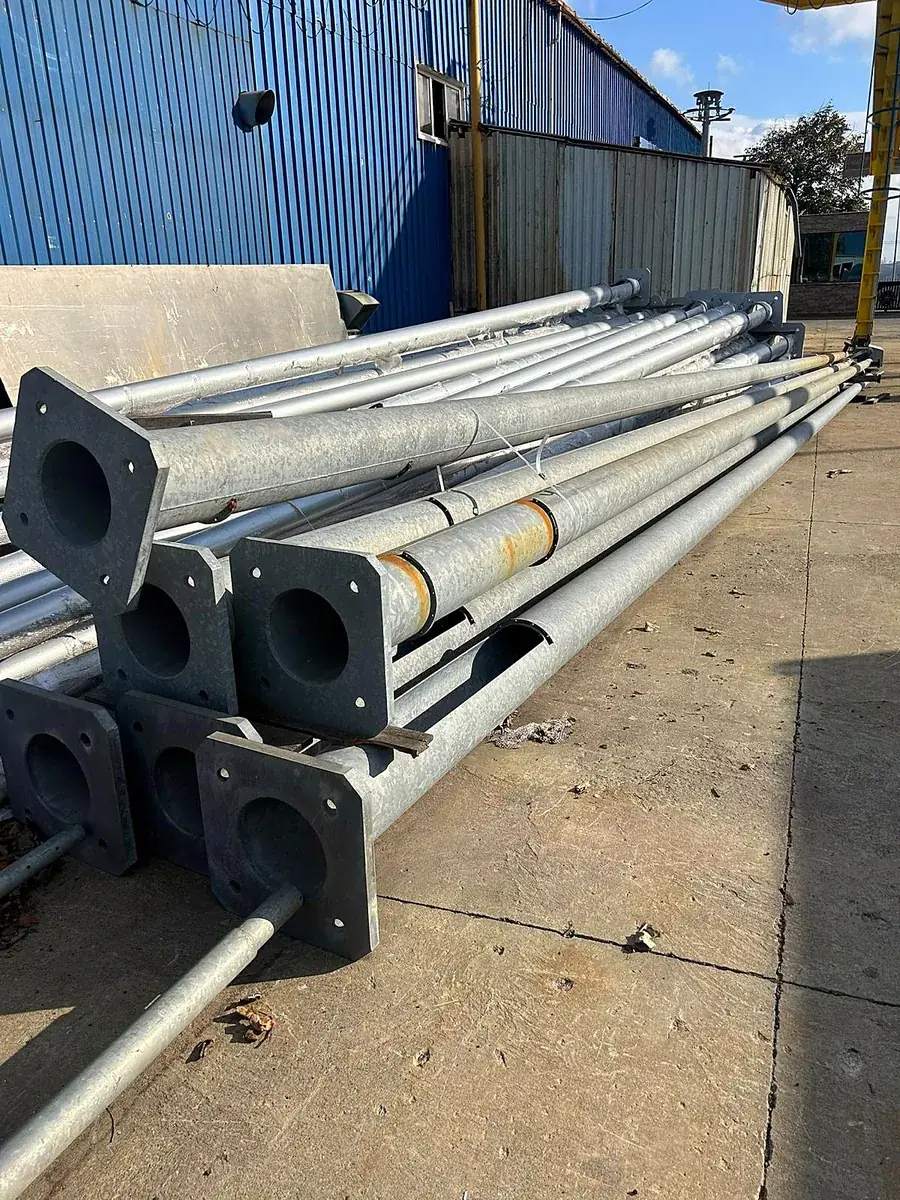
The material comparison in full — cost, weight, repairability and what happens where the two meet — is in the lighting pole materials guide.
What does chromate pre-treatment do, and why does it matter here?
A powder coating does not bond to bare aluminium reliably, and untreated aluminium under a coating is where filiform corrosion starts — the thread-like creep that lifts paint from an edge or a drilled hole. Artay applies a chromate conversion pre-treatment to cast aluminium before electrostatic powder coating. The conversion layer both anchors the coating and passivates the metal underneath, so a scratch does not become a spreading front.
This is the single detail most often missing from a coastal specification, and it is invisible on delivery: two poles that look identical in the yard behave completely differently in year five. Ask any supplier, in writing, what pre-treatment is applied before coating. “Powder coated” on its own is not an answer.
How should the coating be specified for a coastal project?
Name the corrosivity category rather than the colour alone. State the pre-treatment. State the film thickness. And ask for the warranty to be written separately for coastal conditions — a generic warranty figure quoted for all environments is a warranty written for the inland case.
On galvanized steel, the zinc to EN ISO 1461 is the primary protection and any coating over it is a duplex system, which needs the galvanized surface prepared correctly or the paint will not hold. On aluminium, the chromate conversion layer plays the equivalent role. In both cases the weak points are the same: edges, holes, the door aperture and the base flange.
What about the parts that are not the pole?
This is where most coastal installations actually go wrong. Fixings: stainless fasteners are normal on the coast, but stainless in direct contact with aluminium or zinc sets up a bimetallic couple, so the contact needs isolating washers or bushes — specify them, because they are the first thing value-engineered out. Anchor bolts and the base: the foundation interface stays wet and collects chloride; a flange-plate pole on a raised concrete plinth drains, a pole planted at pavement level does not. Cable entry and the access door: water that gets in does not get out, and the earthing point inside the door is the first thing to corrode. The luminaire itself: gaskets and its own housing material matter as much as the pole, and a CE-marked luminaire to EN 60598-2-3 is the baseline, not the coastal answer on its own.
What should a coastal specification actually say?
| Item | What to write |
|---|---|
| Corrosivity category | Name it — C4 or C5 for a coastal site, not left blank |
| Aluminium pre-treatment | Chromate conversion before electrostatic powder coating |
| Steel protection | Hot-dip galvanized to EN ISO 1461, with duplex coating if painted |
| Structural verification | EN 40-3-1 for loads, EN 40-3-3 by calculation, covering the foundation anchors |
| Fixings | Stainless with isolating washers or bushes at aluminium and zinc contacts |
| Base | Flange plate on a raised plinth so the interface drains |
| Door and cable entry | Sealed entry, lockable door, earthing point specified |
| Warranty | Stated separately for coastal conditions, in writing |
What can Artay supply for a coastal project?
Cast aluminium poles, bollards and luminaire housings from our own foundry in Başakşehir, Istanbul, in EN AC-46000 (AlSi9Cu3) alloy with chromate pre-treatment and electrostatic powder coating; hot-dip galvanized steel poles to EN ISO 1461; and combinations of the two. Luminaires are CE marked, and manufacturing is certified to TSE under TS EN 40 for lighting columns and to ISO 9001 for quality management.
We do not make high-mast poles, and we buy in extruded aluminium profile rather than extruding it ourselves — as most of this market does. What we do make from nothing is a form: because the aluminium is cast rather than fabricated, a promenade or marina can have a pole of its own. A new die is cut in our own tool shop in four to six weeks, a first delivery follows seven to nine weeks after drawing approval, and repeat orders on that die ship in three weeks. Changing only height, diameter, arm length or RAL colour needs no die at all and carries no minimum order.
Send a drawing, a 3D model, a photograph or a written specification to info@artaylighting.com and we will come back with a technical drawing and a wind-load calculation.
Related guides
- What drives the cost of a lighting pole — what moves the price, what a quotation leaves out, and how to compare two of them.
- Lighting pole materials — galvanized steel, cast aluminium and extruded profile compared in full.
- Street lighting pole types — the four families and what each is good at.
- Bollard lights — why bollards are aluminium and never galvanized steel.
- Urban lighting: a specifier’s guide — standards, obtrusive light and choosing the pole.
- Ancient cities collection — the fifty models named after ancient Anatolian settlements.
- Street lighting poles for Iraq – what Ministry of Electricity specification D-13 requires, and why EN 40 alone is not an answer there.
- Lighting poles for Kuwait – why MEW/S-1 excludes street lighting columns, and what applies instead.
- Lighting poles for Georgia – zero duty since 2008, diagonal cumulation with the EU, and what 2,435 mm of rain a year does to a pole.
- Lighting poles for Greece – the ELOT technical specification a tender actually cites, CE marking and the A.TR certificate.
- Lighting poles for Croatia – HRN EN editions, the exact date CE marking became mandatory, and designing for the bura.
- The EN 40 series explained – which part does what, which one carries CE marking, and what EN 40 leaves to other standards.