
Only four of these eight export markets specify a lighting column through EN 40. The other four each do something different. Croatia, Greece, Moldova and Serbia each work to their own national adoption of the European standard, under four different prefixes. Georgia leaves it voluntary outside regulated fields. Iraq and Kuwait use national specifications that are not EN 40 at all. And in Kosovo we could not confirm that the adoption exists. A supplier who sends the same technical file to all eight is answering four of them and guessing at the rest.
Artay Lighting has run its own aluminium die-casting foundry in Başakşehir, Istanbul since 1999 and exports to more than 33 countries. These eight are the markets we actually ship poles into, which is why we researched them one at a time and wrote a page for each. This page is the comparison across them: what a tender cites, where it is published, and what crosses the border. We do not make high-mast poles, and we buy in extruded aluminium profile rather than pressing our own.
What does a lighting pole tender actually cite in each market?
The first table groups the four markets that adopt EN 40 nationally. The prefix matters more than it looks: a tender in Zagreb will not accept a reference to SRPS, and a tender in Belgrade will not accept HRN, even though both point back to the same European text.
| Market | What the tender cites | Where tenders are published | At the border |
|---|---|---|---|
| Croatia | HRN EN 40-1:2008, HRN EN 40-2, HRN EN 40-3-1:2013, HRN EN 40-3-2:2013, HRN EN 40-5:2008; HRN EN 13201-2; HRN EN ISO 1461:2022 | EOJN, the Electronic Public Procurement Classifieds, at eojn.nn.hr, within the Official Gazette | EU–Türkiye Customs Union (Decision 1/95). CEFTA stopped applying on EU accession in July 2013. |
| Greece | ELOT TP 1501-05-07-02-00:2009, which calls up ELOT EN 40-1, 40-2, 40-3-1, 40-3-2, 40-3-3, 40-5, 40-6, 40-7 and 40-9, plus ELOT EN ISO 1461 | ESIDIS at portal.eprocurement.gov.gr runs the procedure; KIMDIS is the publication register | EU–Türkiye Customs Union. Free circulation evidenced by the A.TR movement certificate. |
| Moldova | SM SR EN 40-1 to 40-5. The SR in the prefix shows the adoption route runs through the Romanian version of the European standard. | MTender at mtender.gov.md, operated by the Ministry of Finance | Türkiye–Moldova FTA, in force 1 November 2016; the Annex II phase-out completed 1 November 2020, so industrial goods move duty-free both ways. |
| Serbia | SRPS EN 40-1:2012, 40-3-1, 40-4:2012, 40-5:2016, 40-6:2012, 40-7:2016; SRPS EN 13201-5:2016 | Portal javnih nabavki at jnportal.ujn.gov.rs, operated by the Public Procurement Office. Documents in Serbian. | Türkiye–Serbia FTA, in force 1 September 2010. Ask your forwarder to name the proof of origin against Protocol II rather than assuming it. |
The other four markets are not variations on the same theme. They are four separate regimes, and the difference is not cosmetic:
| Market | What the tender cites | Where tenders are published | At the border |
|---|---|---|---|
| Georgia | No mandatory national standard for lighting columns. Under the Product Safety and Free Movement Code No. 6157-IS, mandatory requirements apply only in a regulated field; elsewhere the supplier may choose which requirements to meet. | State Procurement Agency, on the Unified Electronic System at tenders.procurement.gov.ge | Türkiye–Georgia FTA, signed 21 November 2007, in force 1 November 2008. Industrial goods at zero duty. |
| Kosovo | AKS, the Kosovo Agency for Standardization, adopts European standards under the SK EN and SK EN ISO prefixes. We could not confirm that SK EN 40, SK EN 13201 or SK EN ISO 1461 exist. | e-Prokurimi at e-prokurimi.rks-gov.net, under Public Procurement Law No. 04/L-042. Interface in Albanian, Serbian and English. | Türkiye–Kosovo Free Trade Agreement. |
| Iraq | Specification D-13, the Ministry of Electricity reference, revision year 2009 with a 2013 update. It was published in full as an annex to a UNDP procurement notice, which is where a foreign bidder can actually read it. | No single national e-procurement portal of the kind Greece, Croatia or Georgia operate. | No free trade agreement with Türkiye. The relationship runs through a Joint Economic Commission and an April 2024 memorandum. |
| Kuwait | MEW/S-1 explicitly excludes street lighting columns. Clause A.1.2 of the Ministry of Electricity and Water specification says it does not cover street and external lighting on lighting columns; clause A.1.3 does cover car park, decorative, bollard and facade lighting. For columns the hierarchy is IEC first, British Standards second. Of the EN 40 series we could confirm only GSO EN 40-7:2023 adopted as a Gulf Standard. | Central Agency for Public Tenders, under the Public Tenders Law. Announcements weekly in Arabic in the official gazette, Kuwait Al-Youm. | No FTA with Türkiye and none with the GCC, so no preferential rate and no A.TR or EUR.1 route. Conformity runs through KUCAS, the Kuwait Conformity Assurance Scheme. |
Which of these markets accept CE marking as the answer?
Two of them, without qualification: Croatia and Greece are EU member states, so the CE route is the route. Everywhere else CE is useful evidence rather than the legal basis, and the tender may still ask for something local on top.
This matters for a Turkish manufacturer more than it looks, because CE marking is what lets a single technical file serve several markets. Where CE is not the legal basis, the file still travels – but the covering argument changes from “this product conforms” to “this product was built and tested to the following standards, and here is the evidence”.
What actually changes the pole, market by market?
The standard decides the paperwork. The site decides the pole. Across these eight, five distinct design drivers show up, and they do not follow the standards map at all:
| Driver | Where it bites | What it changes |
|---|---|---|
| Salt air | Greek islands, the Adriatic coast, Batumi, the Gulf coast, southern Iraq | Material choice and pre-treatment, not just paint colour |
| High wind | The bura on the Croatian coast | Design wind load, and therefore wall thickness and base plate |
| Extreme heat | Iraq at 55 °C, Kuwait where the surface temperature runs above the air temperature | Door and gear tray detail, coating system, and what sits inside the pole |
| Wide annual range | Moldova, with roughly a 64-degree annual swing | Expansion at the joints and the fixings |
| Inland continental | Serbia, Kosovo, Tbilisi, inland Iraq | The least demanding case – do not over-specify it and pay for coastal protection you will not use |
The mistake we see most often is a buyer applying one national standard and one coastal specification to a whole country. Batumi and Tbilisi are not the same job. Basra and Erbil are not the same job.
Where could we not confirm the answer?
Two places, and we would rather say so than write something that reads well and is wrong.
In Kosovo, AKS publishes European standards under the SK EN prefix, but at the time of writing we could not confirm that SK EN 40, SK EN 13201 or SK EN ISO 1461 have been adopted. If you are bidding there, ask the contracting authority to name the designation in writing rather than assuming a national EN 40 exists.
In Serbia, we could not confirm from the agreement text which proof-of-origin form applies under the free trade agreement. Ask your forwarder to name it against Protocol II. What we can say is that the agreement is in force and covers industrial goods.
These two gaps are the reason this page exists as a comparison rather than a claim. Six of the eight we could pin to a named document. Two we could not, and those are exactly the two where a supplier confidently quoting a standard should make you ask where they got it.
What does this mean if you are sourcing poles from Türkiye?
Three things, in order of how much money they save.
Name the designation in the enquiry. Not “EN 40” but “SRPS EN 40-5:2016” or “HRN EN 40-3-1:2013”. A manufacturer who can quote against the exact designation is a manufacturer who has read the tender; one who answers “yes, EN 40” to all eight has not.
Separate the dimensional question from the form question. Height, diameter, wall thickness, arm length, door position and RAL colour are set per project: no new tooling, no minimum order. A change of form needs a die, and a die costs 4,000–50,000 USD depending on part size, carries a 1,000–2,000 piece minimum, and takes four to six weeks to cut. First delivery follows seven to nine weeks after drawing approval; a repeat order on an existing die is three weeks with no minimum and no tooling charge. Most suppliers answer these two as though they were one question, which is how a project ends up paying for a mould it did not need.
Decide the corrosion case per site, not per country. The coastal specification costs more and is worth it on the coast. Applying it inland is money spent on nothing. The full argument is in the coastal lighting poles guide.
What can Artay supply into these markets?
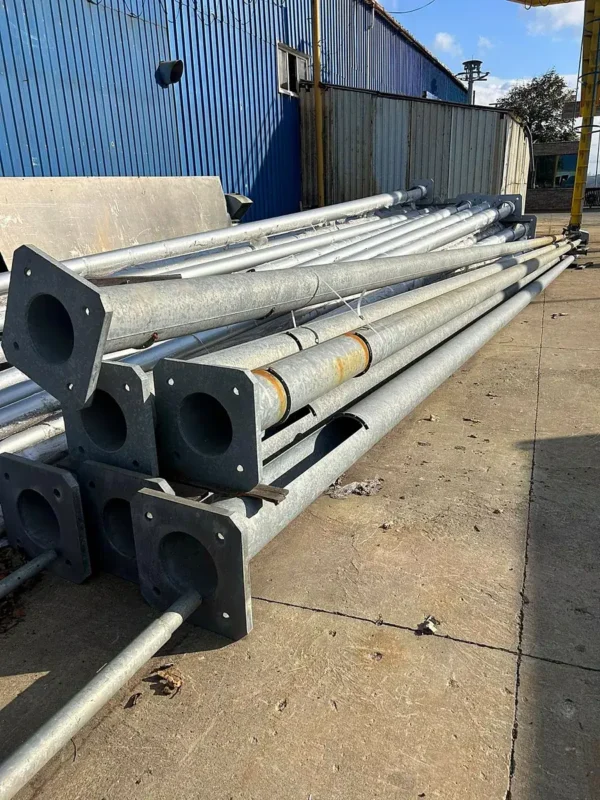
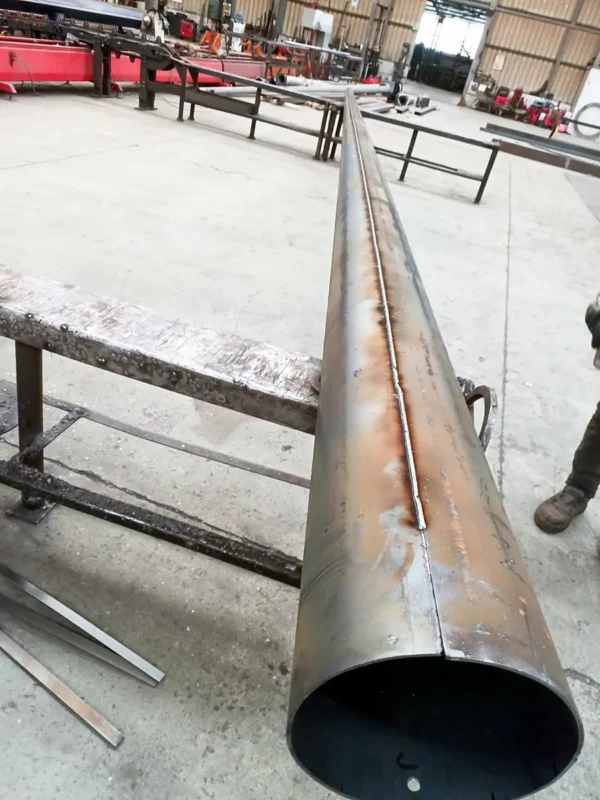
Street lighting poles to 12 m, urban and decorative poles at 3–8 m, and bollard lights at 0.6–1.2 m. Aluminium bodies are cast in EN AC-46000 (AlSi9Cu3) in our own foundry, chromate pre-treated and electrostatically powder coated. Steel columns are cut, folded and hot dip galvanized to EN ISO 1461 to order. Manufacturing is certified to TSE under TS EN 40 for lighting columns and to ISO 9001 for quality management; luminaires are CE marked.
Above 12 m the answer is a high-mast pole and we do not make one. Say so early in a tender rather than late.
Send the tender document, a drawing, a 3D model or a written specification to info@artaylighting.com – and if the tender names a national designation, send that line too. It is the fastest way to a quote that means something.
The eight market guides in full
- Croatia — HRN editions, the bura, and Adriatic corrosion.
- Greece — the ELOT technical specification a tender actually cites, and what changes on an island.
- Moldova — the SM SR route, the 2026 origin change, and a 64-degree annual range.
- Serbia — SRPS designations, CE marking in a non-EU market, and inland sites.
- Georgia — voluntary standards, the free trade agreement, and why Batumi differs from Tbilisi.
- Kosovo — how conformity works, and what we could not confirm.
- Iraq — Specification D-13, 55 °C, and how tenders reach a foreign bidder.
- Kuwait — MEW/S-1, surface temperature, dust and the Gulf coast.
Related guides
- EN 40 lighting column standards — what each part of the series actually covers.
- What a lighting pole costs — mould economics, minimum orders and lead times in full.
- Lighting pole materials — galvanized steel or aluminium, and what happens where they meet.
- OEM and private label lighting poles — producing under a distributor’s own brand.
- Street lighting pole manufacturers in Türkiye — how to compare them, and what none of them publish.