


Aluminium and galvanized steel are not competing on quality – they are competing on site conditions. Galvanized steel is stronger for the money and goes higher; aluminium survives salt air without a maintenance clock and keeps its appearance at street level. Which one belongs in your specification is decided by two things: the corrosivity category of the location and the height of the pole. Not by which material sounds better.
Artay Lighting has run its own aluminium die-casting foundry in Başakşehir, Istanbul since 1999, and exports to more than 33 countries. We make both – die-cast aluminium bodies and bases in our own plant, and welded steel columns cut, folded and galvanized to order. We do not make high-mast poles, and we buy in extruded aluminium profile rather than pressing our own, like most of this market. What follows is the reasoning we give the specification engineers who ask us which one to write into a tender.
How long does each material last before it needs maintenance?
This question has an arithmetic answer for steel and no answer at all for aluminium, and that asymmetry is the whole comparison in one line.
Hot dip galvanizing to EN ISO 1461 puts a measured thickness of zinc on the steel. For articles that are not centrifuged the standard sets a mean coating thickness of 85 micrometres with a local minimum of 70 micrometres on steel thicker than 6 mm; on steel between 3 mm and 6 mm it is 70 micrometres mean with a 55 micrometre local minimum. Once the pole is in service that zinc corrodes at a rate set by the atmosphere, and those rates are classified by ISO 9223 and used throughout ISO 12944.
| Corrosivity category | Typical location | Zinc loss per year | 85 micrometres lasts |
|---|---|---|---|
| C2 | Rural, low pollution | 0.1 – 0.7 µm | 120 years or more |
| C3 | Urban and inland, moderate pollution | 0.7 – 2.1 µm | 40 – 120 years |
| C4 | Industrial areas, coastal with moderate salinity | 2.1 – 4.2 µm | 20 – 40 years |
| C5 | Marine, high salinity | 4.2 – 8.4 µm | 10 – 20 years |
| CX | Offshore and tropical marine | 8.4 – 25 µm | 3 – 10 years |
The last column is simple division, and it is worth being precise about what it measures: the time until the zinc is consumed and the steel needs attention, not the moment the pole falls down. It is also conservative, because real galvanized coatings usually come out thicker than the standard minimum.
Aluminium has no equivalent clock. It forms its own oxide layer and that layer reforms when it is damaged. This is the difference that matters most in practice: on a galvanized steel pole the coating is part of the corrosion protection, so a deep scratch starts a countdown. On an aluminium pole the coating is cosmetic, and a deep scratch stays a scratch.
What does EN 40 actually require of each?
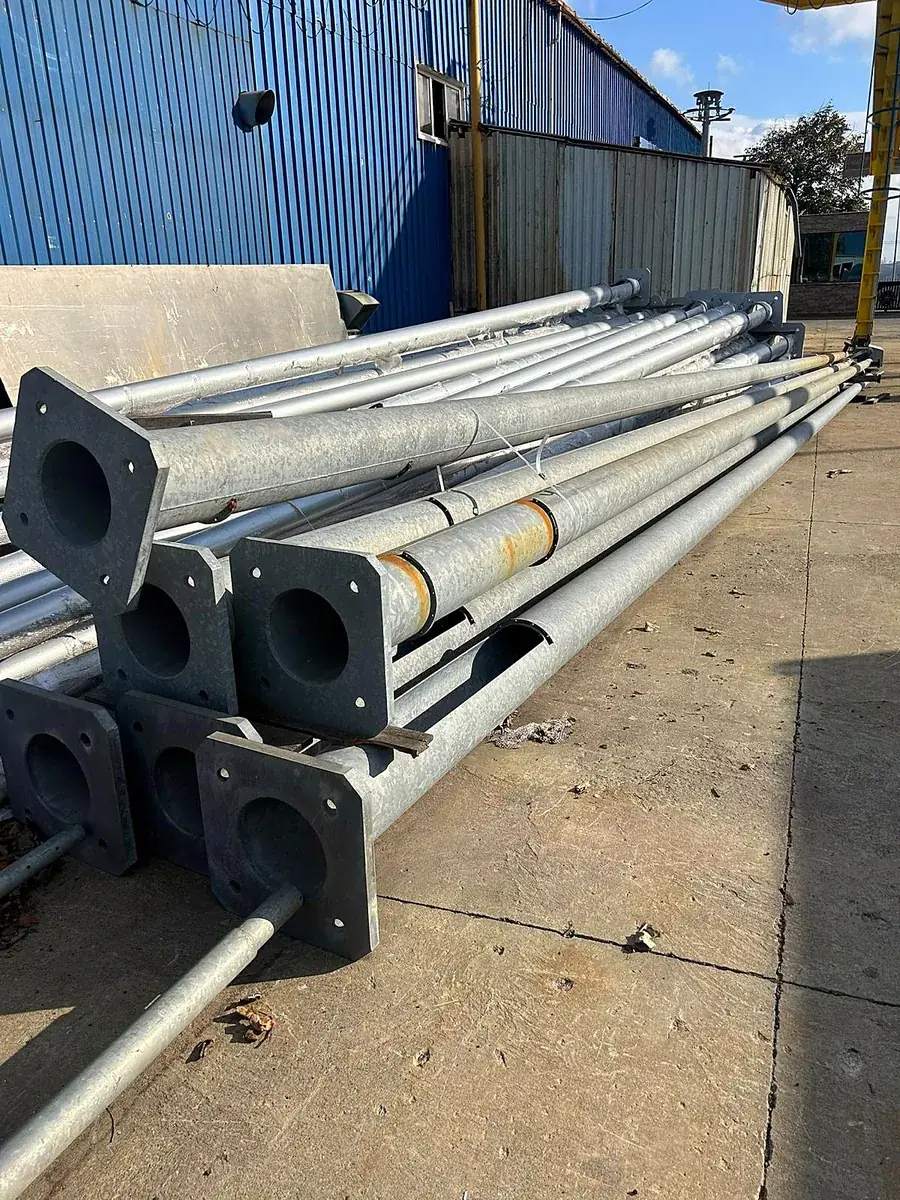
Both materials sit inside the same standard series and are verified against the same loads. EN 40-3-1 sets the characteristic loads, EN 40-3-2 verifies a design by testing and EN 40-3-3 verifies it by calculation. Only then do the requirements split by material: EN 40-5:2002 covers steel lighting columns and EN 40-6:2002 covers aluminium ones.
The practical consequence for a tender is that the phrase “compliant with EN 40” says nothing about material on its own. A specification that wants aluminium has to name EN 40-6, and one that wants steel has to name EN 40-5. Naming only EN 40-3-3 leaves the material entirely open, which is how a buyer expecting aluminium ends up receiving a compliant steel quotation. Our guide to which part of EN 40 does what sets out the full series and what each part governs.
The aluminium shafts used for lighting columns are normally extruded from EN AW-6060 or EN AW-6063 in T6 temper, while the cast parts – bases, door frames, brackets – are produced in a casting alloy such as EN AC-46000 (AlSi9Cu3). That casting alloy is what we pour in our own foundry; the extruded profile we buy in.
Why are bollards aluminium and eight-metre road poles usually steel?
Because those two heights face completely different threats, and the material that answers one does not answer the other.
A bollard lives between roughly 0.5 and 1.2 metres. Everything that damages a coating happens at exactly that height: shoes, trolleys, kerb-side salt, strimmers and mowers, snow ploughs, the corner of a delivery pallet. On galvanized steel each of those events removes zinc from a small area and rust starts at the scratch. That is why our bollards are aluminium with a chromate pretreatment and electrostatic powder coating, and why we do not offer a galvanized bollard at all.
Above about six metres the calculation inverts. Wind load on the shaft and on the luminaire grows with height, section sizes have to grow with it, and steel delivers more strength per unit of cost than aluminium does. Nothing at that height is being scraped by a trolley. Our own range stops at 12 metres – we do not make high-mast poles, and when a project needs 15 or 20 metres we say so rather than quoting it. The full range of shapes and heights is set out in our guide to street lighting pole types.
Which one behaves better when a vehicle hits it?
Passive safety is covered by EN 12767, and the 2019 revision changed the vocabulary enough to cause real confusion in tenders written since. Occupant safety levels were renamed from numbers to letters: what used to be NE2 is now NE-C, and HE3 is now HE-C. Energy absorption is still described as HE for high, LE for low and NE for non-absorbing, and the revision added further codes for backfill type, collapse mode and directional sensitivity. Level A, the highest, is only achievable for deformable items such as bollards – not for lighting columns, sign posts or signal poles.
Aluminium is often chosen for passively safe designs because the alloy tears in a predictable way. But the point that matters for anyone writing a specification is this: passive safety is a tested property of one specific product, not a property of a material. No manufacturer, ourselves included, can claim an EN 12767 class from the alloy alone. If your tender names a class, ask for the crash test report and the classification code for that exact column, at that exact height, on that exact foundation. A supplier who answers with a material rather than a report has not answered.
What does each one cost, and where does the money actually sit?
For a plain road pole of the same height and the same loading, the galvanized steel option is normally cheaper than the aluminium one. But the aluminium cost sits somewhere different, and that difference is worth understanding before assuming aluminium is expensive.
An aluminium column is two things: an extruded shaft, bought in as profile, and cast components that come out of a mould. The profile carries no tooling cost. The castings do, and that is where the real economics live.
| New mould | 4,000 – 50,000 USD depending on part size |
| Minimum order on a new mould | 1,000 – 2,000 pieces |
| Time to cut the mould | 4 – 6 weeks |
| Series production | 3 weeks |
| First delivery from drawing approval | 7 – 9 weeks |
| Repeat order on an existing mould | 3 weeks, no minimum, no mould charge |
The distinction that saves buyers the most money is between changing a dimension and changing a form. Height, diameter, wall thickness, arm length, door position and RAL colour are dimensional changes: no new mould, no minimum order, no tooling charge. A different shape of base, or a different bollard head, is a form change and that does need a mould. Most suppliers answer both questions as though they were one, which is why so many buyers assume that any customisation triggers a thousand-piece minimum. Our guide to what drives the cost of a street lighting pole breaks the rest of it down.
So which one should you specify?
The honest answer is that the site decides, and in most projects it decides quickly once you know the corrosivity category and the mounting height. This is the table we work from.
| Situation | Specify | Reason |
|---|---|---|
| Seafront promenade or harbour, C5 | Aluminium | 85 micrometres of zinc is consumed in 10 to 20 years there |
| Inland city street, C3, 8 to 10 metres | Galvanized steel | 40 to 120 years to first maintenance at lower cost |
| Bollards, anywhere | Aluminium | Coating damage happens constantly at shoe height |
| Decorative or heritage castings | Aluminium | Die-casting holds detail that fabrication cannot |
| Above 12 metres | Not from us | We do not make high-mast poles |
| Tender naming an EN 12767 class | Ask for the test report | The material alone does not establish a class |
Two cases sit outside the table. A coastal project is not automatically C5 – a sheltered bay a kilometre inland can be C3, and the same street can be C5 on the seaward side and C4 behind the first row of buildings. Our guide to coastal lighting poles covers how that judgement is made. And a project buying a decorative pole under its own brand should read what OEM and private label production actually involves, because the mould economics above are the whole conversation.
If you send us the location, the mounting height and the luminaire weight and projected area, we will tell you which material we would put in the quotation and why – including the cases where the answer is that we are not the right supplier.
Related guides
- Lighting pole materials — galvanized steel or aluminium, and what happens where they meet.
- Coastal lighting poles — chloride, chromate pre-treatment and what changes in a seaside specification.
- EN 40 lighting column standards — what each part of the series actually covers.
- Lighting pole standards by country — eight export markets side by side: what each tender cites, where it is published and what crosses the border.
- Bollard lights — glare, spacing, and what belongs in a bollard specification.
- What a lighting pole costs — mould economics, minimum orders and lead times in full.