

A bollard is the only light fitting in the public realm that sits at eye level and gets kicked. Everything that makes bollard lighting different follows from those two facts: the source is in the field of view, so glare control decides whether the product is comfortable or unbearable; and the fitting is at ground level, so the material and the finish decide whether it still looks acceptable in year five.
This guide covers what to specify, the mistakes that are expensive to reverse, and what changes when the bollard has to be made to your own design. Artay Lighting casts aluminium in its own die-cast foundry in Istanbul and fabricates bollards from extruded aluminium profile, so the recommendations here come from making them.
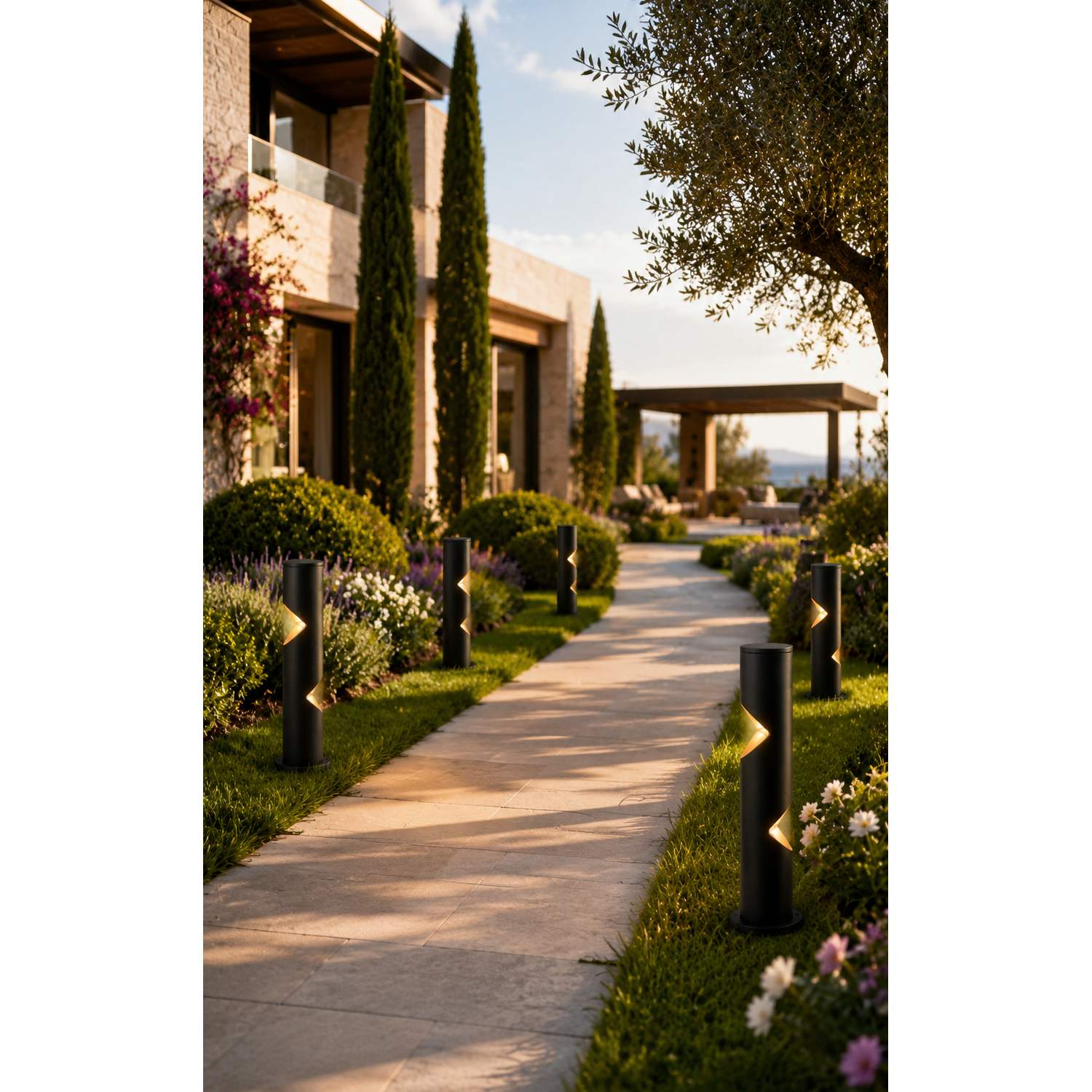
Why are bollard lights made from aluminium and not galvanized steel?
Because ground level is the harshest position on any site. A bollard sits in the splash zone. It takes irrigation water every morning, de-icing salt every winter, cleaning chemicals, and mud thrown up by every passing vehicle. It is also the first thing a mower, a car door or a delivery trolley reaches.
Galvanized steel does not belong there, and we do not make bollards from it at all. Every Artay bollard is aluminium, either cast in our own foundry or fabricated from extruded profile. Aluminium forms its own oxide layer, so its corrosion behaviour in that environment is different in kind rather than merely better.
The finish matters as much as the metal, and this is the step nobody writes into a specification. Aluminium is never coated straight from the die or the extruder. Every part first goes through a chromate conversion pre-treatment: the surface is cleaned and a conversion layer is formed on the metal. That layer gives the coating something to key into and stops corrosion creeping underneath the film from the first stone chip. Electrostatic powder coating follows, applied dry and oven-cured.
Skip the pre-treatment and a bollard can look perfect for one season and then lift in sheets from a single scratch. When you compare quotations, ask which conversion coating is used — not just which paint.
Glare: the reason most bollard installations disappoint
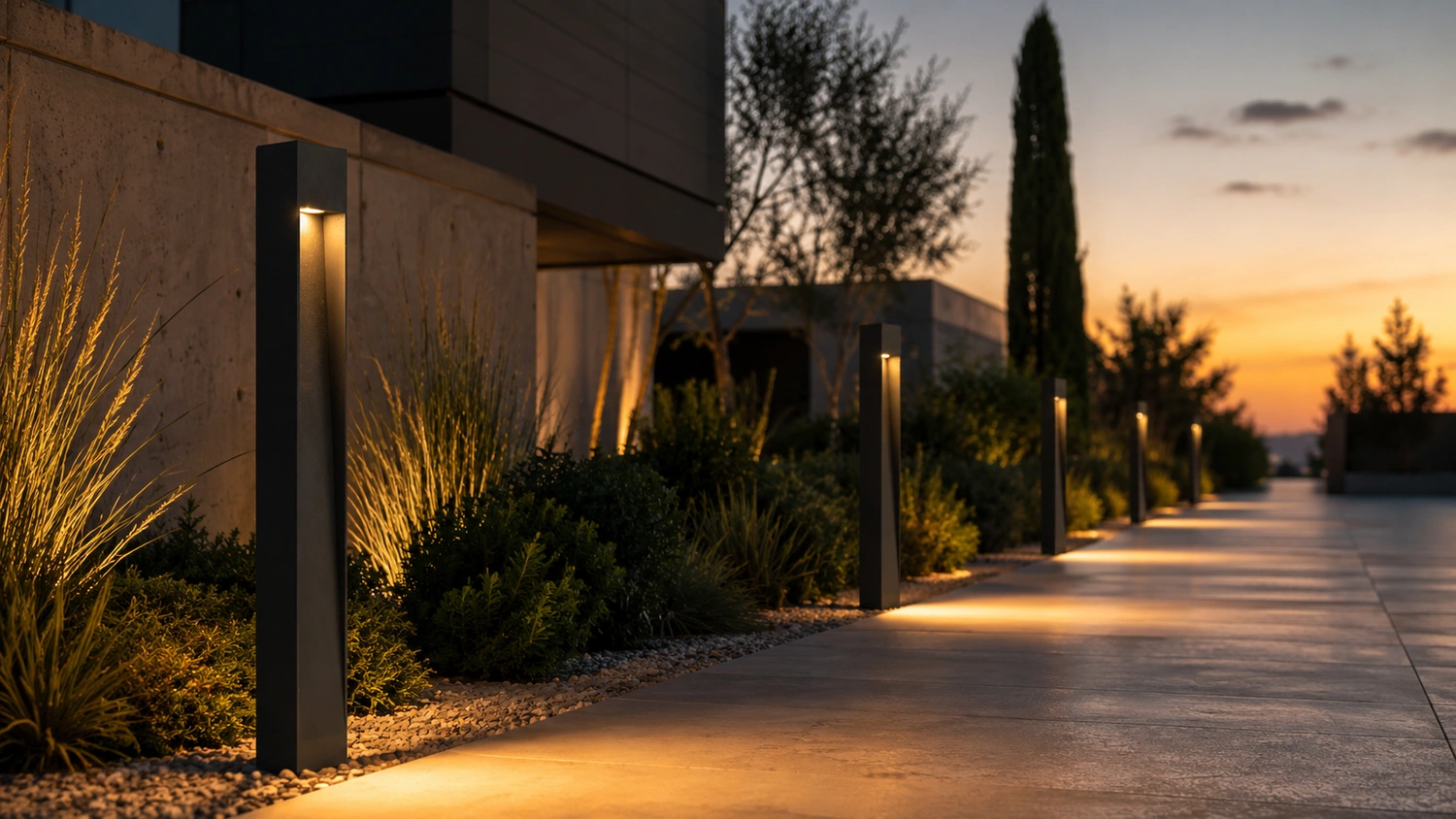
At 3 m mounting height a badly controlled luminaire is a nuisance. At 0.9 m it is directly in the eye line of everyone walking past, and of every driver at a car park entrance. Glare is not a refinement in bollard lighting; it is the primary optical requirement.
Four optical types cover most of the market. Full cut-off puts all light below the horizontal, with the source hidden behind a shield — the safest choice next to roads and car parks. Louvred designs use internal blades to hide the source while distributing light around the fitting. Opal diffuser types glow evenly and read as a marker rather than a light source, which suits promenades but wastes light upward unless the top is closed. Asymmetric optics throw light to one side, which is what a path edge actually needs and what most projects fail to ask for.
Ask for the photometric file, not a picture. A bollard that looks discreet in a catalogue photograph can still put a bright source straight into the eye line at ten metres.
What should be in a bollard specification?
- Height. 0.6-1.2 m covers almost everything. Lower units mark an edge; taller units light a wider path. Below 0.6 m the fitting starts to disappear under snow and planting.
- Optical distribution. Symmetric 360°, asymmetric, or full cut-off — chosen from what is being lit, not from the styling.
- Ingress and impact protection. IP66 is a sensible baseline at ground level because the fitting will be hosed and splashed. IK08 for normal public areas, IK10 where vandalism is a genuine risk. These are two different ratings and a strong IP tells you nothing about impact.
- Mounting. Base plate on a cast foundation can be replaced after an impact; root-mounted units are planted directly, cost less and are harder to replace. In vehicle areas, plan for the impact rather than hope.
- Cable entry and drainage. The most common failure in bollards is water standing inside the base. Ask how the fitting drains, not only how it seals.
- Colour temperature. 3000K is the usual public-realm choice, and 2700K increasingly where planting, wildlife or residential windows are close.
- Maintenance access. Whether the gear tray can be reached without digging out the base, and whether one person can do it.
Which standard applies to a bollard?
This catches people out in tender documents. A bollard is certified as a luminaire, under EN 60598-2-3 for road and street lighting luminaires, together with its IP and IK ratings. It is not certified as a lighting column under the EN 40 series, which governs the structural design of columns.
So if a specification asks for EN 40 documentation on a 0.9 m bollard, the request is misdirected — what you actually want is the luminaire certification, the photometric file and the IP/IK ratings. Artay luminaires are CE marked and our manufacturing is certified to ISO 9001; for lighting columns we hold TSE certification under TS EN 40, which is a separate matter from the bollard range.
How far apart should bollards be spaced?
Spacing is an output of the lighting calculation, not a rule, and the calculation is worth doing because bollards are bought in quantity and a wrong spacing multiplies. As an orientation before the calculation exists, path lighting with bollards commonly lands at three to four times the mounting height — so roughly 3 to 4 m apart for a 1 m bollard — and closer where uniformity along the path matters, such as at steps, ramps and crossings.
Two things push spacing tighter than people expect. Foliage grows and blocks light within two seasons. And the useful light from a bollard falls off fast, because the source is close to the surface it lights.
Can bollards be made to your own design?
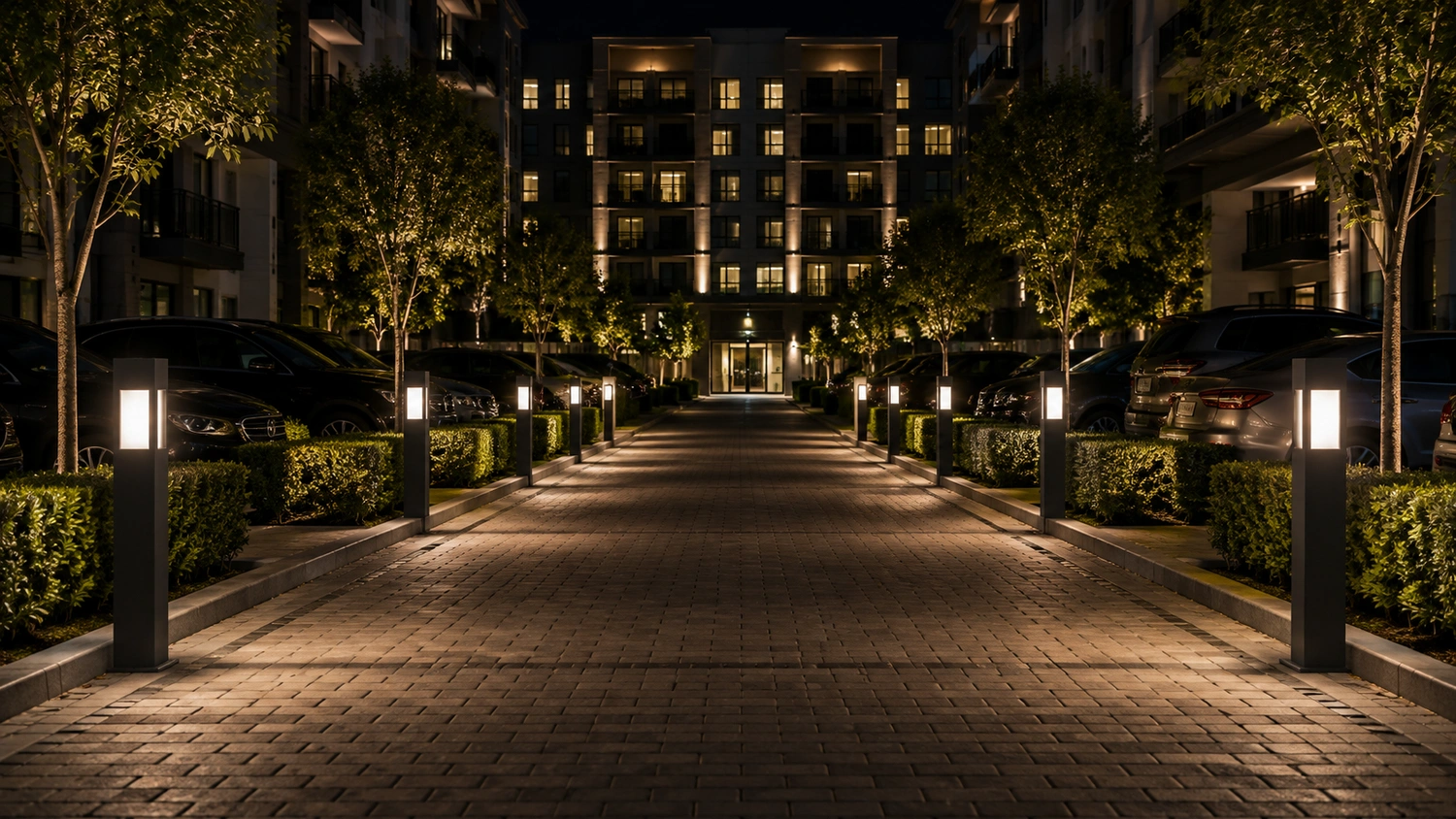
Yes, and it is worth separating two different requests, because suppliers answer them as if they were one.
Changing an existing bollard — height, diameter, RAL colour, optic, base detail — is a fabrication and finishing change. There is no tooling cost and no minimum order. If your requirement differs from a catalogue only in numbers and colour, you should not be paying for a mould.
Changing the form — a profile that matches a building, a cap carrying a municipal emblem, a shape that exists in no catalogue — has to be cast, and casting needs a die. Send a technical drawing, a 3D model or a photograph of a form you have seen somewhere, and we cut the die in our own tool shop.
The figures, which almost nobody in this market publishes: a new mould is a one-time cost of 4,000-50,000 USD depending on part size and then stays reserved for you; minimum order on a new mould is 1,000-2,000 units; the die takes 4-6 weeks and production a further 3 weeks, so first delivery lands 7-9 weeks after drawing approval, and every repeat order ships in 3 weeks with no further mould charge.
If the quantity does not reach that minimum, say so early — a form achievable in extruded profile costs no tooling at all, and we would rather tell you that than sell you a die you do not need.
Five bollard mistakes that cost money
- Specifying galvanized steel. Ground level is where steel struggles most. Aluminium belongs there.
- Buying on appearance without the photometric file. Glare at eye level is the one thing a catalogue photograph cannot show you.
- Confusing IP with IK. A sealed fitting is not an impact-resistant fitting.
- Root-mounting in a vehicle area. The first impact turns a fifteen-minute replacement into an excavation.
- Ignoring the pre-treatment. The coating is not what fails; the interface underneath it is.
Working with Artay on bollard lighting
We manufacture bollard and low-level lighting alongside street lighting poles, decorative urban poles and LED street luminaires, and we export to more than 33 countries. Bollard bodies are cast in our own die-cast foundry in Istanbul or fabricated from extruded aluminium profile, chromate pre-treated and powder coated, and we produce under OEM and private label agreements for distributors and lighting brands.
Send a drawing, a 3D model, a photograph or a written specification to info@artaylighting.com.
Related guides
- Coastal lighting poles — chloride, chromate pre-treatment and what changes in a seaside specification.
- Ancient cities collection — the fifty models named after ancient Anatolian settlements, with the site behind each name.
- Urban lighting: a specifier’s guide — standards, obtrusive light and the decisions that are expensive to reverse.
- Lighting pole materials — galvanized steel or aluminium, and what happens where they meet.
- Street lighting pole types — how to choose the right one for your project.
- Decorative lighting poles — styles and materials for parks, plazas and pedestrian zones.
- Street lighting pole manufacturers in Turkey — what nine manufacturers publish about casting, standards and lead times.
- Lighting poles for Kuwait – why MEW/S-1 excludes street lighting columns, and what applies instead.
- Garden and landscape lighting — mounting heights, EN 13201 P classes and the obtrusive light zones that decide a park or garden scheme.