


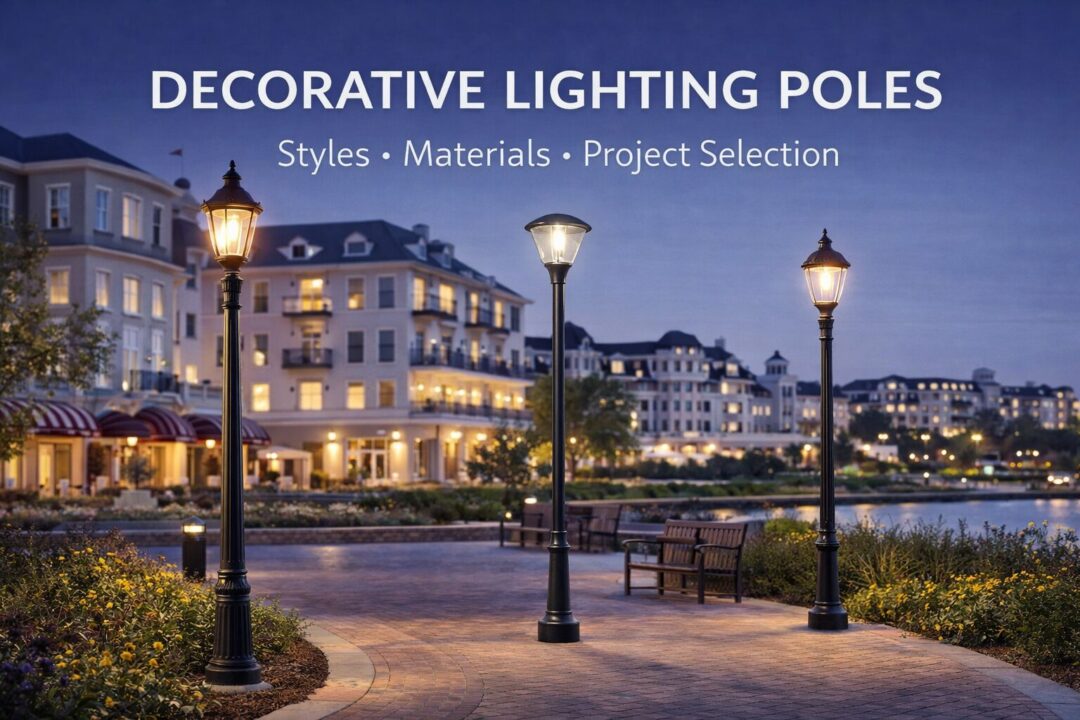
A decorative lighting pole is judged twice: once at night as a lighting instrument, and once by day as a piece of street furniture that will stand in the same spot for thirty years. That second judgement is why architects and municipalities specify decorative poles at all, and it is the one most catalogues ignore. A pole that photographs well and corrodes at the base flange has failed, and so has a pole that lasts thirty years in a form nobody wanted.
Artay Lighting has cast aluminium in its own die-cast foundry in Istanbul since 1999 and exports to more than 33 countries. Because the aluminium is cast rather than fabricated, a decorative form that does not exist yet can be made — which is a different conversation from choosing between catalogue styles, and this guide covers both.
What are decorative lighting poles?
Decorative poles are outdoor lighting structures designed with aesthetics as a primary requirement—without sacrificing structural safety and corrosion resistance. They commonly feature classic silhouettes, ornamental details, and styled brackets that fit specific environments such as heritage areas or premium landscapes.
Where decorative lighting poles are used
- Historic streets & heritage zones
- Parks, gardens, and promenades
- Town squares and public plazas
- Hotels, resorts, and waterfronts
- Residential communities and premium landscapes
- Retail streets and pedestrian-focused districts
In these areas, the “look” is not optional. The pole must match paving, benches, signage, and the overall architectural language.
Popular styles of decorative lighting poles
1) Classic / heritage poles
- Traditional profiles with ornamental bases and classic brackets
- Works well in old-town streets, heritage promenades, and municipal squares
2) Contemporary decorative poles
- Cleaner lines than heritage poles, but still “designed” and premium
- Common in modern plazas, mixed-use developments, and commercial landscapes
3) Lantern-style and globe-style decorative poles
- Creates a recognizable “street identity” for pedestrian zones
- Important to control glare and light spill with proper optics/shields
4) Single vs. multi-luminaire decorative poles
- Single-head: cleaner look, easier maintenance
- Multi-head: iconic appearance for squares and entrances (requires careful photometrics)
Materials: what works best for decorative poles
Galvanized steel
- Strong and cost-effective for municipal and public projects
- Excellent corrosion protection when hot-dip galvanized
- Ideal base for powder coating (decorative color finishes)
Aluminum
- Naturally corrosion resistant and lighter to handle
- Common in premium landscapes and coastal-friendly selections
- Supports refined detailing and smoother surface finishing
Reality check: A decorative pole is only as good as its coating system and manufacturing quality. If the base preparation is weak, the most beautiful pole will age poorly outdoors.
Finishes & colors: the “project identity” layer
Decorative poles are often specified in signature colors to match a district brand or architectural palette. The finish must resist UV exposure, moisture, and abrasion.
- Powder coating (most common for decorative color finishes)
- Hot-dip galvanizing as base protection
- Multi-layer coating systems for harsh climates (coastal/industrial)
What to define in your spec:
- Color code (commonly RAL)
- Surface texture (matte / satin)
- UV resistance expectations
- Touch-up and maintenance approach
Key specifications to check before you buy
1) Pole height (match the area type)
- 3–5 m: pedestrian areas, parks, paths
- 6–8 m: streets, residential roads
- 9–12 m: boulevards and wider roads (less common for “ornamental” styles)
2) Bracket style and outreach
- Bracket outreach affects light distribution and uniformity
- Choose bracket style that matches both aesthetics and photometrics
3) Glare control and optics
- Lantern/globe designs can cause glare if optics are poor
- Ask for shield/optical options for pedestrian comfort
4) Base design and anchor system
- Decorative bases should still meet structural requirements
- Confirm base plate, anchor bolt pattern, and foundation details
5) Service access and wiring
- Access door quality matters for long-term maintenance
- Ensure safe cable routing and grounding provision
What do architects actually ask for when specifying decorative poles?
In our experience the questions arrive in a consistent order, and almost none of them are about style. Can the form be changed? — whether the supplier can produce a shape that suits the facade rather than a catalogue silhouette. What is the daytime appearance? — the pole is a vertical element in the streetscape at eye level, so the section, the taper and the base profile matter more than the luminaire. What is the finish, exactly? — RAL number, gloss level and, on coastal or de-iced sites, what pre-treatment sits under the coating.
Then the practical ones. Does it match the rest of the street furniture? Benches, bollards and litter bins are usually specified together, which is why a supplier who can also cast a matching bollard is worth more than one who cannot. Can it be repeated in ten years? A municipality replacing a damaged pole in year twelve needs the same form, not the nearest current model — with a cast product the die still exists, and that is the honest reason to ask who owns the tooling. And what does the deviation cost? — the answer is different for a dimensional change and a form change, and most suppliers blur the two.
The last one is worth being precise about, because it decides the budget. Changing height, diameter, arm length, door position or RAL colour needs no tooling and carries no minimum order. Changing the form means cutting a die: a one-time cost of 4,000–50,000 USD with a minimum of 1,000–2,000 units, the die cut in 4–6 weeks, first delivery 7–9 weeks after drawing approval, and repeat orders on that die in 3 weeks with no further charge. The full commercial picture is on the OEM and private label page.
Can a city have a decorative pole of its own?
Yes, and this is the case our foundry exists for. A cast part comes from a mould, so a base carrying a municipality’s emblem, a fluted column matched to a historic street, or a pole family unique to one square is ordinary work rather than a special project. Send a technical drawing, a 3D model, or a photograph of a form you have seen somewhere, and we return a technical drawing with a wind-load calculation before anything is committed.
Two honest limits. If your quantity does not reach the minimum, say so early — in many cases the form can be achieved in fabricated steel or extruded profile without a die at all, and we will tell you that rather than sell you tooling you do not need. And we do not make high-mast poles, so a decorative treatment above 12 m is not something we can offer.
Our own decorative range runs to about fifty models named after ancient Anatolian settlements — Ephesus, Aphrodisias, Zeugma, Xanthos and others. The ancient cities collection lists all of them with the site behind each name.
Which standards apply to a decorative pole?
The same ones that apply to any lighting column, and a decorative form does not exempt a pole from them. The EN 40 series is the reference: EN 40-2 for dimensions and tolerances, EN 40-3-1 for characteristic loads, EN 40-3-3 for verification by calculation, EN 40-5 for steel columns and EN 40-6 for aluminium columns. Hot-dip galvanizing is governed by EN ISO 1461 and luminaires by EN 60598-2-3. For Turkish municipal and TEDAŞ work, TEDAŞ type-project approval is the document that will be asked for.
Artay luminaires are CE marked, and manufacturing is certified to TSE under TS EN 40 for lighting columns and to ISO 9001 for quality management. Cast bodies are produced in EN AC-46000 (AlSi9Cu3) alloy with a chromate pre-treatment before electrostatic powder coating. Ask any supplier for the certificate together with its scope — a certificate covering luminaires does not cover columns, and on a decorative project the column is the part being argued about.
How to choose decorative lighting poles (simple checklist)
- Define the environment style (heritage, modern plaza, resort, park)
- Select pole family (same silhouette across the whole area)
- Choose height based on mounting and spacing
- Confirm bracket style + outreach with luminaire photometrics
- Pick material + coating system based on climate
- Lock the finish color and texture (project identity)
- Standardize spare parts and maintenance access
Common mistakes
- Choosing style without photometrics: beautiful poles can still produce poor lighting
- Ignoring glare: decorative optics must protect pedestrian comfort
- Inconsistent families: mixing silhouettes makes the streetscape look random
- Weak coatings: decorative colors fade and chip if the system is not specified properly
Need help selecting decorative lighting poles?
Share your project location, target heights, area type (park/street/plaza), and preferred luminaire style. We can recommend a decorative pole family and finish system that matches both aesthetics and durability requirements.
Browse outdoor models in our Street Lighting category and select a consistent pole family for your project.
Related pole guides
- Street lighting poles — types, heights, galvanized steel and what a custom pole actually costs.
- Modern outdoor lighting poles — LED-ready pole designs and materials for streets, parks and new developments.
- Outdoor lighting poles — types, heights and materials for any outdoor project.
- Modern lighting poles — design and material choices for public spaces.
Specifying bollards? Bollard lights: how to choose and specify them — why they are aluminium and not galvanized steel, glare control at eye level, and which standard actually applies.
Steel or aluminium? Lighting pole materials: galvanized steel or aluminium — coastal performance, chromate pre-treatment, and what happens at the joint where the two metals meet.
Not sure which type you need? Street lighting pole types: how to choose the right one — steel, extruded aluminium, die-cast and bollards compared on height, corrosion environment, EN 40 standards and what changes when the form is made to your own drawing.
Choosing a supplier? Street lighting pole manufacturers in Turkey: how to compare them — what nine Turkish manufacturers publish about casting, standards, certificates and lead times, and the five questions worth asking every supplier.
All of these poles are produced by the same manufacturer: Artay casts housings and pole components in its own die-cast foundry in Istanbul, which is why a form that exists in no catalogue can still be produced. See the LED lighting fixtures manufacturer in Istanbul behind these guides, or browse the full outdoor and street lighting product range.